

REALTOR AI PLAYBOOK · 23
Better Marketing. Stronger Conversations. Practical AI.
A photo shoot becomes easier to plan when you can finish this sentence: “The buyer needs to understand…” Start there before choosing formats, counting images or writing captions.
For a home with several structures, the answer might be “how the house, workshop and covered storage relate to one another.” For an interior-focused property, it might be “how the main living spaces connect.” Those are different communication problems. They should lead to different coverage decisions.
Write one communication question, list the facts still to verify and identify three images that could help answer it. You now have the beginning of a useful production brief. This chapter builds that into a shot list, a content plan and a prompt you can adapt before the photographer arrives.
A real property, a clearly labeled planning exercise
The photographs in this article come from Magic Lens's published Haines City acreage project. They show a residence, a red workshop, covered storage and open land. The archived case discusses why the relationships between those elements mattered to the visual coverage.
The brief below is an educational planning example based on that visible portfolio material. It is not the original client brief, a new booking or a statement that the property is currently available. No sales outcome is being attributed to the images.
Proposed communication focus: help a viewer understand the house and separate structures as parts of one property. That focus is specific enough to guide image selection without inventing a lifestyle, a permitted use or a buyer profile.
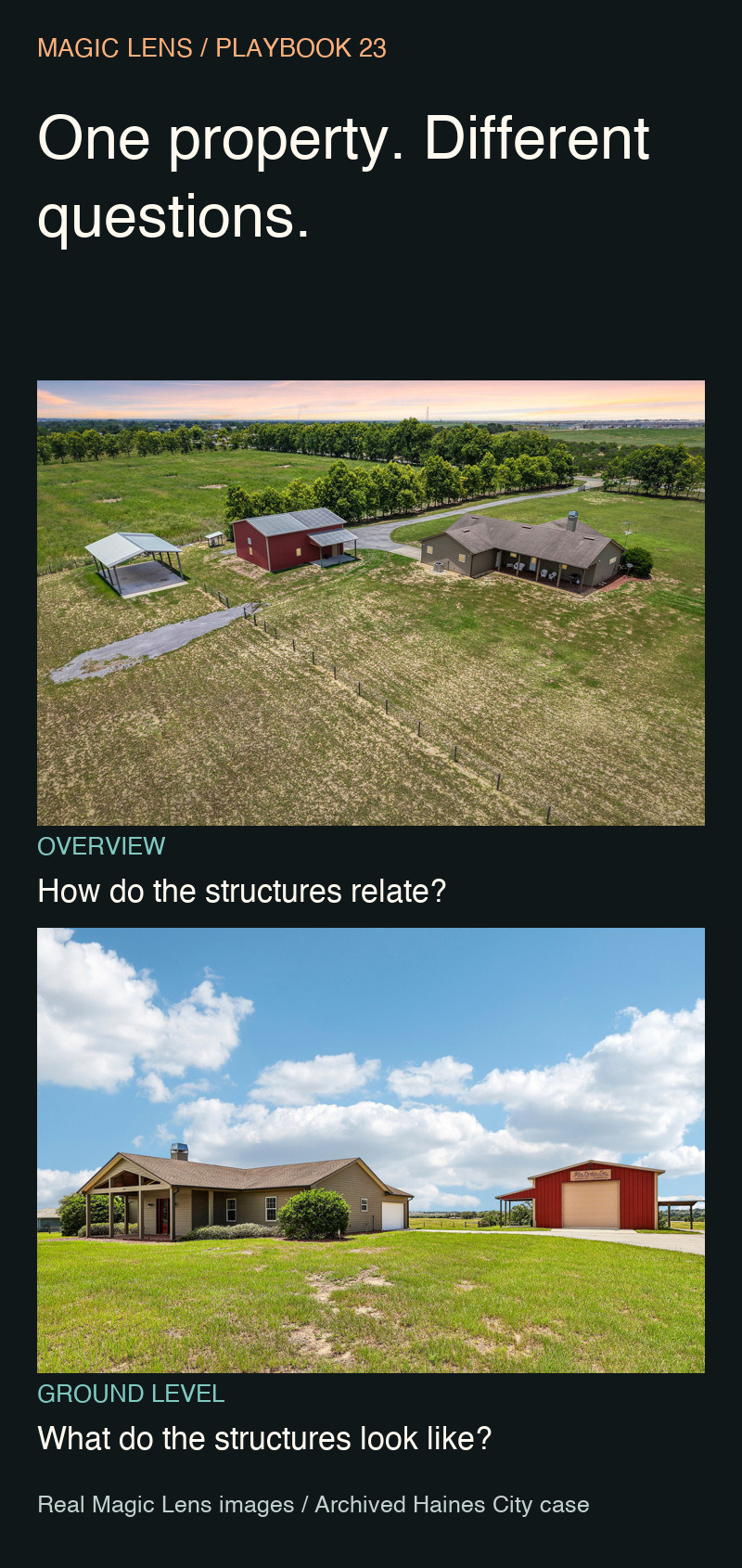
Choose one organizing question, not one repeated caption
Before: “Get great shots of everything and make it look impressive.” After: “Help the viewer understand the relationship between the residence and separate structures, then give each important space enough detail to be recognizable.” The second instruction gives the production conversation a direction without dictating an unsafe angle or promising a specific capture.
A clear story does not mean saying the same thing in every post. It means the material answers a coherent set of questions. The overall view establishes the relationship; ground-level photographs explain individual structures; interior coverage shows the spaces themselves.
For this planning exercise, the organizing question is: “How do the home and other visible structures connect?” Supporting questions include what each structure looks like, how it is approached and what remains unclear from the images.
Do not turn a visible workshop into a claim about operating a business, storing a particular vehicle or adding another building. Dimensions, condition, permissions and intended uses need appropriate verification. A photograph can introduce a question without resolving it.
Ask these questions before choosing the media
- What must the marketing explain? Name the feature, relationship or spatial question in plain language.
- Which facts are confirmed? Separate supplied records from impressions and seller descriptions that still need checking.
- What could be missed? Identify useful areas that a standard room-by-room sequence might overlook.
- What needs preparation? Confirm access, readiness, people, pets and any areas that should not be photographed.
- Where will the material be used? Define the actual channels and orientations needed, subject to their current requirements.
- Who reviews accuracy and scope? Identify the responsible people before production decisions become commitments.
Keep private access details out of public documents and AI prompts. The photographer may need operational information through the agreed private channel; your public marketing brief does not need to contain security codes or a seller's schedule.
A shot list with a job for every frame
Use a simple structure: question, proposed image, intended use and verification limit. The photographer can then refine the approach based on access, light, conditions, safety and the agreed scope.
1. Overall relationship. Proposed image: an overview that keeps the residence, workshop and covered storage recognizable. Intended use: an opening image or overview slide. Limit: it is not a survey or proof of legal boundaries.
2. Human-scale exterior. Proposed image: the house and workshop from the ground. Intended use: introduce the structures without relying only on altitude. Limit: appearance does not establish condition or construction details.
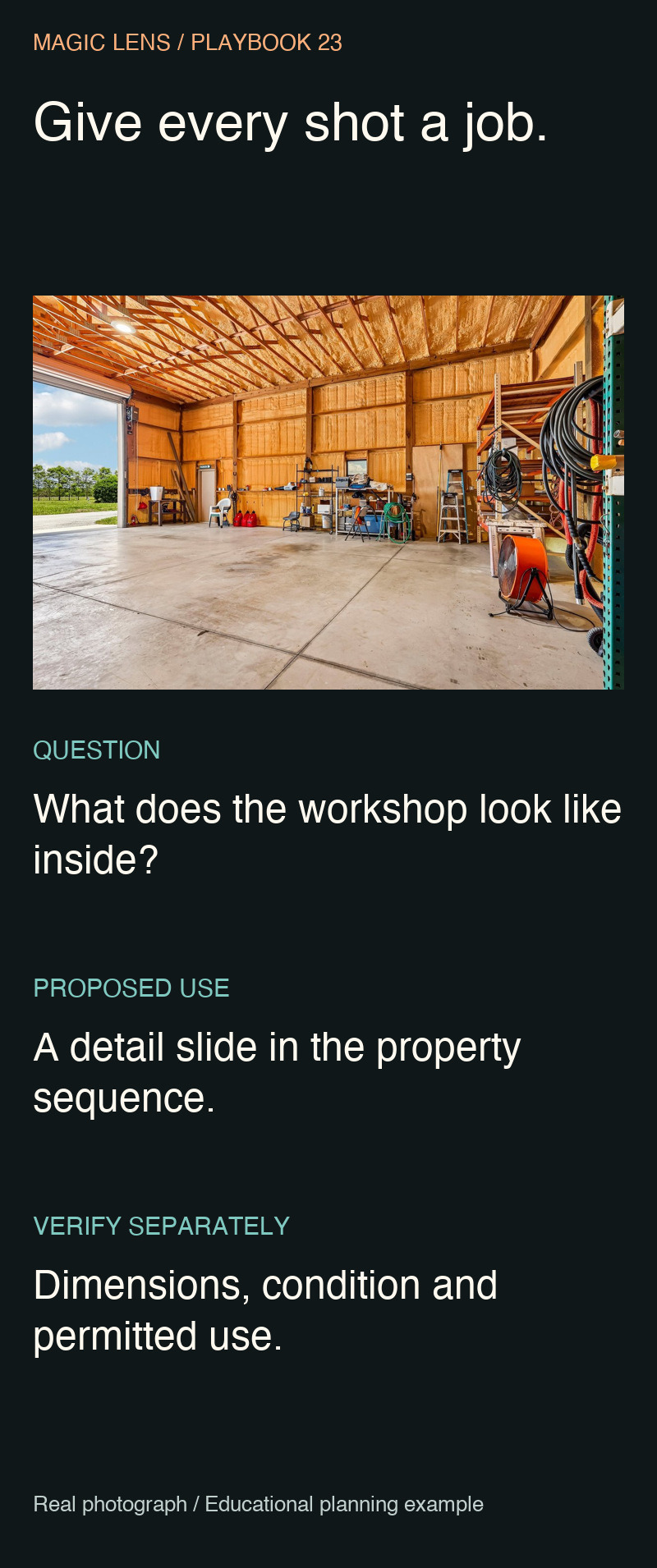
3. Workshop interior. Proposed image: the visible floor area, opening and interior arrangement. Intended use: answer “What does this space look like inside?” Limit: avoid unsupported capacity, dimensions or permitted-use claims.
4. Residential spaces. Proposed images: the agreed main interior coverage. Intended use: explain the home itself so the land does not overshadow the residence. Limit: labels and property facts still need review.
5. A connecting view. Proposed image: a view that helps the viewer move mentally from one area to another. Intended use: connect the gallery sequence. Limit: do not imply a route or access right that has not been confirmed.
This is a planning shortlist, not a guaranteed capture list. Confirm the production scope and let the media professional address feasibility. If an image cannot be captured appropriately, revise the communication plan rather than manufacture the missing view.
Use formats because they answer a question
In the Haines City portfolio example, an aerial perspective shows relationships that the ground-level frames explain differently. That gives drone coverage a specific job. “We should add drone because it looks premium” is a weaker production instruction.
A different property may need carefully sequenced interior photography more than an aerial overview. A short video may help demonstrate a transition when motion adds information. A verified floor-plan deliverable may address a spatial question that a photograph leaves open. Each option needs its own purpose and confirmed scope.
Do not promise every format before discussing the assignment. More assets also create more decisions about preparation, production, review and use. A focused brief helps choose the appropriate set instead of treating the service menu as a checklist everyone must buy.
Plan three useful pieces of content
Overview post: introduce the visible relationship between the house and separate structures. Use the overview image and a factual caption. Avoid implying that everything visible in the distance belongs to the property.
Detail carousel: move from the exterior relationship to the workshop interior and residential spaces. Give each slide one question to answer. Use confirmed labels and keep open questions visible in your internal review.
Visit-preparation message: help an interested person identify which spaces they want to understand during an appropriate visit. Do not present a fictional appointment slot or imply current availability from an archived photo.
These are proposed outputs for the exercise, not posts that have already been published or tested. Their usefulness depends on accurate facts, suitable images and the actual listing context.
Prompt ChatGPT to organize the production brief
Create a practical pre-shoot brief in American English.
This is an educational planning exercise, not a confirmed booking.

PROPERTY CONTEXT:
Visible portfolio images show a home, separate red workshop,
covered storage and open land. Current listing status, dimensions,
boundaries, condition and permitted uses are not supplied.

COMMUNICATION QUESTION:
How do the home and the separate visible structures relate?

Create:
- A one-sentence communication focus.
- A list of facts to verify before writing public claims.
- Five proposed shots, each tied to a viewer question.
- The intended use and verification limit for each shot.
- Three content ideas that use different information.
- Preparation, scope and review questions for the team.

Do not invent property facts, access instructions, buyer demographics,
bookings, prices, results or production commitments. Do not recommend
every media format automatically. Separate visible observations from
facts that require records or qualified review.
Replace the exercise context with a concise, sanitized summary of your own assignment. Review the result with the appropriate people. ChatGPT can organize the brief; it cannot inspect the property or confirm that a proposed image is feasible.
Two refinements before production
For each proposed shot, finish this sentence: "This image helps the
viewer understand..." Flag repeated shots and unsupported claims.
Identify any important question that the current list does not answer.
This checks whether the list is purposeful. Two similar frames may be justified, but the brief should explain why both are needed instead of simply increasing the image count.
Turn this brief into a concise handoff. Separate confirmed facts,
open questions, proposed coverage, preparation owners and review steps.
Do not convert proposed work into a promise or add operational details
that have not been supplied.
This checks whether the plan can be acted on. A beautiful paragraph is not a handoff if nobody knows which question remains open or who should resolve it.
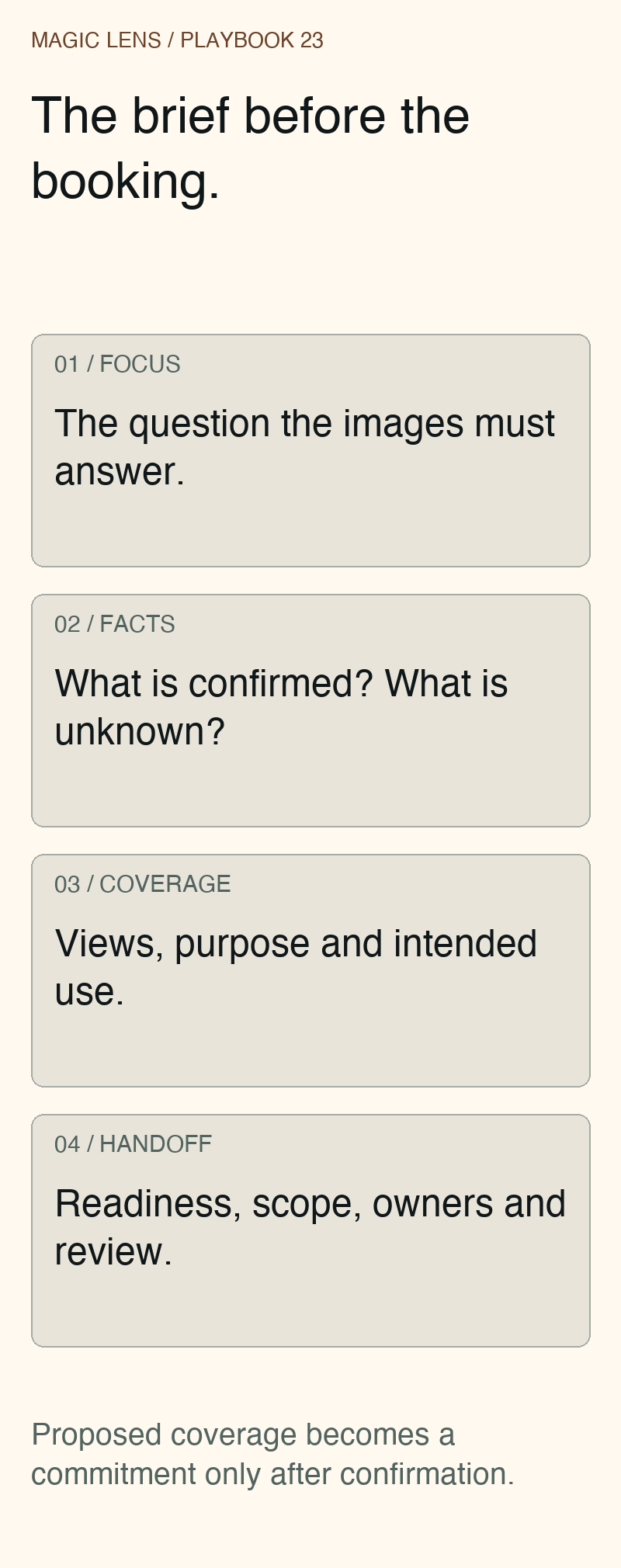
Your one-page production brief
COMMUNICATION QUESTION:
CONFIRMED PROPERTY FACTS:
FACTS STILL TO VERIFY:
ESSENTIAL VIEWS AND THEIR PURPOSE:
INTENDED CHANNELS AND ORIENTATIONS:
PREPARATION OWNERS:
ACCESS AND SCOPE QUESTIONS TO RESOLVE PRIVATELY:
FACT REVIEW AND APPROVAL OWNER:
PROPOSED CONTENT AFTER DELIVERY:
You can complete this structure manually without AI. Begin with one question and three purposeful views, then expand only where the property requires it. Leave unknowns explicit until the right person confirms them.
A completed handoff you can actually use
Educational adaptation of the archived Haines City photographs—not the original client brief. The priorities below are proposed for this exercise, not a confirmed production order.
BRIEF: Haines City visual-relationship exercise / v1 / Oct 24, 2026
QUESTION: How do the residence, separate workshop and covered storage relate?
SOURCE: Archived Magic Lens portfolio photographs reproduced in this article.
OBSERVED: Residence; separate red workshop; covered storage; open land.
NOT VERIFIED: Current listing status, dimensions, boundaries, condition, permitted uses.

ESSENTIAL TO THE PROPOSED STORY:
1. Relationship overview. Purpose: orient the viewer. Use: opening image.
   Confirmation owner: photographer for capture feasibility; listing agent for labels.
2. Ground-level residence and workshop. Purpose: recognize each structure.
   Use: gallery / carousel. Owner: photographer and listing agent.
3. Workshop interior, if access and scope are confirmed.
   Purpose: show the visible interior. Use: detail slide.
   Owner: listing agent confirms access privately; photographer confirms coverage.
4. Agreed residential interior views. Purpose: explain the home itself.
   Use: listing gallery. Owner: listing agent confirms included spaces.

OPTIONAL, NOT AUTOMATIC:
- Aerial overview only if feasible and it adds the spatial relationship needed.
- Connecting video only if a real transition answers a viewer question.
- Additional detail frames only if they supply new information.

PENDING BEFORE BOOKING:
Agent: verify property facts and intended channels; confirm image-use rights.
Owner / manager: confirm readiness and restrictions through a private channel.
Photographer: confirm feasible views, orientation, deliverables and scope.
No dates, prices, included labor or deliverable counts are agreed by this example.

PUBLIC CLAIM LIMIT: Describe what is visible; do not infer legal boundaries,
workshop capacity, permitted business use, condition or current availability.
REVIEW: Listing agent checks facts; photographer confirms production scope.
A compact home needs a different brief
Fictional example: the confirmed task is to show how a compact home's kitchen, dining area and living room connect. Essential views are an honest connecting angle, a clear view of each room and a sequence that preserves the actual arrangement. Aerial coverage is not justified by that communication question. Add it only if a separate, verified exterior question makes it useful—not because it appears in a package. Room dimensions and current availability remain unknown unless supplied.
Copy a clean brief into your working document
BRIEF NAME / VERSION / DATE:
COMMUNICATION QUESTION:
SOURCE MATERIAL AND PERMISSION TO USE IT:
VERIFIED FACTS + SOURCE / DATE:
VISIBLE OBSERVATIONS (not independently verified facts):
ESSENTIAL VIEW | VIEWER QUESTION | INTENDED USE | CONFIRMATION OWNER:
1.
2.
3.
OPTIONAL VIEW | WHAT NEW INFORMATION IT ADDS | OWNER:
UNKNOWNS | WHO CONFIRMS | WHERE THE ANSWER WILL BE RECORDED:
PREPARATION TASK | OWNER | STATUS | PENDING ACTION:
CHANNEL / ORIENTATION REQUIREMENTS TO CHECK:
SCOPE / ACCESS QUESTIONS (handle sensitive details privately):
FACT REVIEWER / PRODUCTION REVIEWER:
APPROVED VERSION / REMAINING QUESTIONS:
Copy the entire block into an editable document. Fill the essential rows first; delete optional rows that do not answer a real question. Keep unknowns visible until their named owner supplies evidence.
Your next useful task
Turn the brief into the right coverage
Your brief now connects each planned message to an image or sequence. Before the shoot, resolve the gaps: which views are essential, which details need close coverage and whether another format adds useful information. The goal is coverage that serves this property, not the largest possible package.
Explore Magic Lens services and pricing to match your brief to photography and visual media for a listing in Orlando, Winter Garden or Central Florida.