

A useful listing Reel starts with one idea and the footage that proves it.
Choose a Quick Tour to show the route through a home, a Realtor-led Reel to answer one buyer question, or a creative edit to emphasize a distinctive feature.
Choose the message before filming.
Then plan the opening, essential scenes and next step together. A full property film can develop several spaces; a Reel works better when its purpose is easy to follow.
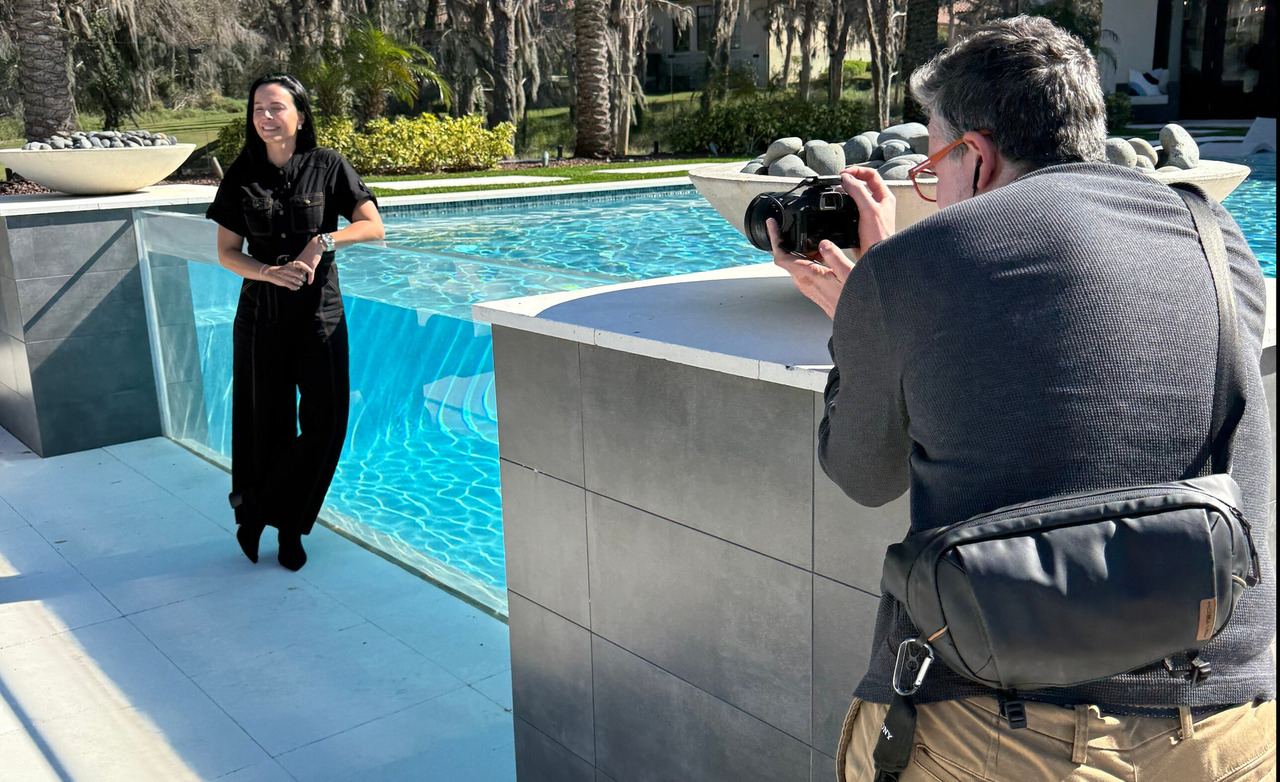
Decide What the Viewer Should Do Next
A new-listing Reel may invite viewers to explore the full gallery or ask the agent about a showing. A Realtor-led explanation may answer a recurring question and invite a more specific conversation.
Choose the destination before filming so the ending feels connected to the story. Keep the property facts and contact route consistent with the listing that viewers will actually open.
Message: The kitchen and covered lanai work as one entertaining area.
Footage: Establish the kitchen, show the opening toward the lanai and finish with a clear outdoor view.
Next step: Invite the viewer to explore the complete property gallery.
A Reel and a Full Property Film Have Different Jobs
When I produce a longer property video, I have more room to establish the exterior, move through the house, develop visual rhythm and let important spaces breathe.
A Reel forces more selection.
If I try to show every bedroom, every bathroom, the entire kitchen, pool, drone footage, community amenities and the Realtor speaking—all in one short video—the result often becomes a checklist moving too quickly.
Short-form content becomes stronger when something is intentionally left out.
The question becomes:
Three Reel Formats I Would Consider for a Listing
Simple movement through the property when the objective is to give the viewer a fast sense of space and flow.
The Realtor becomes part of the content and uses the property to explain one idea, feature, objection or market point.
A more edited piece built around movement, details, transitions, music, storytelling and the features that make the property visually distinctive.
1. Quick Tour Reel
Keep the movement simple and let the property do the work.
A Quick Tour works when the house itself is the message.
The viewer does not need a long explanation.
They need a fast visual sense of what the property feels like to move through.
- Minimal or simple editing
- Clear movement through important spaces
- Good choice for homes with strong natural flow
- Useful when the Realtor does not need to appear on camera
- Works best when the route through the home is planned before filming
A one-take video looks simple after it is finished.
That does not mean I walk through the front door and improvise the entire route.
I want to know where I start, where I turn, which room deserves more time and where I can finish without making the camera movement feel forced.
Simplicity on screen still requires planning behind the camera.
A Quick Tour Does Not Need to Show Every Room
This is one place where the name can be misleading.
A Quick Tour does not have to become a complete inspection of the property.
If moving through a secondary bathroom breaks the flow, I may leave it for the photography gallery.
If the strongest route is foyer → living room → kitchen → pool, that may be enough for that particular Reel.
2. Realtor-Led Reel
The listing becomes the setting for the Realtor's point of view.
This is a very different type of video.
Instead of asking only, “How do I show this house?”, I ask:
“What does the Realtor have to say about this house?”
- One clear opening idea
- Realtor on camera or speaking in voiceover
- Property footage used as visual proof
- Better for explaining a feature, objection or buyer situation
- Can build the Realtor's personal brand while marketing the listing
The House Should Support What the Realtor Is Saying
Suppose the opening is:
Now I know what I need to capture.
I need the exterior.
I need the transition through the living space.
I need the doors opening toward the pool or lanai.
I need footage that proves the opening line.
The mistake would be filming a generic property tour first and deciding on that hook three days later.
The message and the footage should know about each other.
I Prefer One Idea Per Talking Reel
The Realtor does not need to describe the entire listing verbally.
The MLS description already exists.
I would rather build one Reel around:
- One surprising property feature
- One buyer objection
- One lifestyle advantage
- One unusual layout decision
- One neighborhood or location angle
- One question buyers repeatedly ask
That usually gives the video a clearer reason to exist.
3. Immersion or Creative Reel
This is where the edit becomes part of the experience.
An Immersion Reel is not simply a Quick Tour with more cuts.
I use different focal lengths, movement, close-up details, stronger transitions and sometimes aerial footage to build a more polished short-form presentation.
- Dynamic editing
- Wide shots combined with details
- Intentional transitions
- Exterior and interior movement
- Drone footage when it adds useful context
- Music and pacing used to shape the experience
For this kind of Reel, I am deliberately collecting different types of footage.
I may need a broad kitchen movement, a tighter shot of the lighting, a transition through a doorway, the pool seen from inside and an exterior angle that connects the property to its surroundings.
Those shots are not random decoration.
They give the editor options to control rhythm.
Creative Does Not Mean Complicated
There is a temptation to judge a Reel by the number of transitions, effects or camera tricks inside it.
I do not think that is a useful standard.
Sometimes one clean movement is stronger than ten effects.
Sometimes a simple Realtor joke communicates more personality than a cinematic montage.
Sometimes the architecture is already visually strong enough that the edit needs to get out of the way.
Which Reel Format Should You Use?
Start With the Hook Before You Build the Shot List
I do not mean every Reel needs a loud text hook or someone pointing at the camera.
The hook can be visual.
It can be a question.
It can be movement.
It can be the strongest room appearing immediately.
But I want to know what makes the first moment worth continuing.
Before recording, I would answer these questions:
- Who is this Reel for?
- What is the one idea?
- Does the Realtor need to appear?
- What should the first shot or first sentence be?
- Which 5–8 visual moments are essential?
- Does drone add anything meaningful?
- Is there one transition or reveal worth planning?
- What is the final CTA?
Do Not Film Horizontal and Hope to Fix It Later
When I know the final piece is designed for a phone, I prefer to think vertically during production.
That affects where the Realtor stands.
It affects how I frame a doorway.
It affects whether a chandelier, pool, staircase or kitchen island still works after the frame becomes narrow.
One Listing Can Produce More Than One Reel
This is where I think Realtors leave a lot of value on the table.
They treat the property shoot as if it has to create one final video.
But one listing can often support several short-form ideas.
Let the house itself be the subject.
Use the listing to explain a buyer question, design choice or market point.
Build a shorter concept around the property's strongest visual or a simple story.
That is much more useful than filming three nearly identical property tours and changing only the music.
The Realtor Does Not Need to Become an Actor
Some agents avoid talking Reels because they imagine they need perfect delivery.
I do not think that is the goal.
The camera should not erase the way the person naturally communicates.
I would rather simplify the script.
Shorten the sentences.
Break the scene into pieces.
And build the edit around the Realtor rather than forcing the Realtor to perform a 45-second monologue perfectly.
Some Reels Need a Script. Others Need a Structure.
For a Realtor-led educational video, I may want written lines.
For a Quick Tour, a route may matter more than a script.
For a creative sketch, the timing of dialogue and reactions matters.
For an Immersion Reel, the shot list and music may do most of the storytelling.
I do not want to force every property into the same production formula.
Drone Should Not Be Added Just Because the Reel Needs “Something Cool”
Drone footage can create a strong opening or help establish location and scale.
But I use the same standard here that I use for aerial photography:
What does the aerial shot explain?
- Waterfront relationship
- Acreage
- Community scale
- Pool and house relationship
- Location context
- Meaningful amenities
If it adds none of those things, it may not belong in that Reel.
Think About Promotion Before the Edit Is Finished
If paid distribution is planned, confirm the Reel’s current advertising eligibility and commercial audio rights before approving the edit. Organic publishing and advertising do not always accept the same creative.
My Practical Social Delivery
A 1080 × 1920, 9:16 canvas is a practical working format for this workflow. Preserve a high-quality master and check the requirements in the intended publishing tool.
- Keep the main feature and any on-screen text clear of interface overlays.
- Watch the export on a phone and check that text remains readable.
- Listen to dialogue at a normal volume and correct distracting music levels.
- After upload, check the selected cover, crop, captions and next-step link.
A Reel Is Part of the Listing Media Plan—not the Entire Plan
This matters because short-form video is good at certain jobs and weak at others.
A Reel can create attention.
Professional photography can let someone inspect the rooms at their own pace.
A floor plan can explain layout.
A 3D tour can let a remote buyer explore independently.
Drone can establish location or scale.
Planning a Reel for an Upcoming Listing?
Send me the property, the strongest feature and whether you want the Realtor on camera. That is enough to start deciding which short-form format makes sense.
View Real Estate Reels →What I Want a Realtor to Decide Before the Shoot
Do not wait until the footage is already recorded to answer these.
- Quick Tour, Realtor-Led or Creative / Immersion?
- Who is the intended viewer?
- What is the one message?
- Which room or feature is the hero?
- Will the Realtor speak?
- Do we need a written script or only talking points?
- What footage must exist to support the message?
- Do we need drone?
- Could the content later be boosted?
- What should the viewer do after watching?
The Real Question Is Not “Do I Need Reels?”
I think the better question is:
Sometimes the answer is a property tour.
Sometimes it is the Realtor speaking.
Sometimes it is a visual story.
And sometimes the property does not need an elaborate Reel at all.
That decision is more useful than adding short-form video just because everyone else is posting it.
Frequently Asked Questions
What is a real estate Reel?
A real estate Reel is short-form vertical video created for social media. It can focus on the property itself, feature the Realtor on camera or use a more creative storytelling approach.
What is the difference between a Reel and a full real estate video?
A Reel usually has a narrower objective and faster structure. A longer property film has more time to establish rooms, movement, atmosphere and the overall property experience.
What is a Quick Tour Reel?
It is a simple guided movement through selected parts of the property, often with minimal editing. The route should be planned so the video communicates flow rather than simply walking through every room.
Should Realtors appear in their listing Reels?
Not necessarily. Realtor-led content is useful when the agent has a specific insight, feature, objection or story to communicate. Some properties work better with the house itself as the subject.
How long should a real estate Reel be?
Use enough time to make one idea understandable and give the viewer a clear next step. A single-feature reveal can be shorter than a narrated explanation or a route through several connected spaces. Read the script aloud, build a rough sequence and remove shots that repeat information. Confirm the current duration requirements separately in the destination where you will publish or advertise.
Should real estate Reels be vertical?
For dedicated Instagram short-form content, I prefer building around a 9:16 vertical frame from the beginning rather than cropping a horizontal video after production.
Does every listing need a Reel?
No. The decision should depend on the property, audience, Realtor's marketing plan and what short-form video would add beyond the other listing media.
Can one listing produce multiple Reels?
Yes. A single shoot can sometimes support a property-focused Reel, a Realtor-led educational piece and a creative concept, provided the footage is planned with those different uses in mind.
Do Not Just Order a Reel. Decide What the Reel Needs to Do.
Quick Tour, Realtor-led content or a more immersive short-form edit—the right format depends on the property, your audience and the story you want the listing to tell.
Magic Lens creates professional real estate photography, vertical Reels, video, drone media, Zillow 3D tours and floor plans for Realtors throughout Orlando and Central Florida.

Gustavo Sousa
Gustavo Sousa is a professional real estate photographer, videographer and FAA Part 107 Certified Remote Pilot based in Winter Garden, Florida.
A professional photographer since 2012, he works with Realtors, residential listings, vacation homes, builders and real estate media projects throughout Orlando and Central Florida.
Platform references
Meta — Reels creative guidance: the vertical Reels format and mobile viewing context.
Instagram — Access to the licensed music library: music availability and commercial-use limitations.
The export sizes in this guide are practical workflow choices. Confirm current specifications and advertising eligibility in your publishing tool before posting.