

REALTOR AI PLAYBOOK · 09
Better Marketing. Stronger Conversations. Practical AI.
You have a strong property image and a dramatic opening line. The next scene is another attractive angle, but it does not answer the question you just raised. The Reel looks polished and still feels unfinished.
Before filming or editing, write the first sentence and the evidence that follows it. If you cannot name the scene that fulfills the opening, change the sentence. A useful opening creates a clear expectation that the rest of the piece can satisfy.
This chapter develops three openings for one idea, then turns the strongest match into a complete short sequence. The visuals use real Magic Lens photographs from a published Palm Bay model-home case. The storyboard and wording are editorial proposals, not a finished Reel or a claim about measured performance.
Choose the explanation before the hook
The idea for this example is simple: show how the kitchen relates to the living and dining areas before focusing on individual details. We have two photographs that support different parts of that explanation. One looks across the island toward the living and dining areas. The other gives a closer view of the kitchen.
Those images support a visual relationship. They do not establish exact dimensions, construction quality, current availability or how every buyer would use the space. Keep the opening inside the evidence you have.
A line such as “The perfect kitchen for every family” creates a broad, unsupported claim. “See how the kitchen connects to the living area” gives the viewer a specific thing to observe. The second line is less dramatic, but it gives the sequence a job.
Use the same discipline for educational Reels. If the opening promises three preparation questions, the following scenes should deliver those questions. If it promises a before-and-after comparison, you need an accurate, permitted comparison—not unrelated images that merely look different.
Build an evidence brief for ChatGPT
Help me write three openings for one short real estate video idea.
This is a storyboard exercise, not a request for performance claims.

ONE IDEA: Show the relationship between the kitchen, living and
dining areas before focusing on kitchen details.
AVAILABLE MATERIAL:
- A real photograph looking across the kitchen island toward the
  living and dining areas.
- A real photograph showing the kitchen from another angle.
FORMAT: a sequence made from still photographs and on-screen text.
UNVERIFIED: dimensions, current listing status, buyer suitability,
construction quality and sales results.

For each opening, provide:
1. One sentence in plain American English.
2. The first image that supports it.
3. The next scene needed to fulfill the sentence.
4. One claim we must avoid.

Do not invent rooms, footage, measurements or property facts.
Keep all three options focused on the same idea.
Do not claim that any opening will increase reach or generate leads.
The material list prevents a common failure: the model writes a sequence that requires footage you never captured. If you only have still photographs, say so. A storyboard should help you use available material or identify a real production gap.
Three openings for the same story
Option A: lead with the relationship
“Before the close-ups, see how these rooms connect.”
First image: the wide view across the island toward the living and dining areas. Continuation: move to the kitchen view, then return to the wider context. Avoid: claiming a circulation measurement or that the layout suits every household.
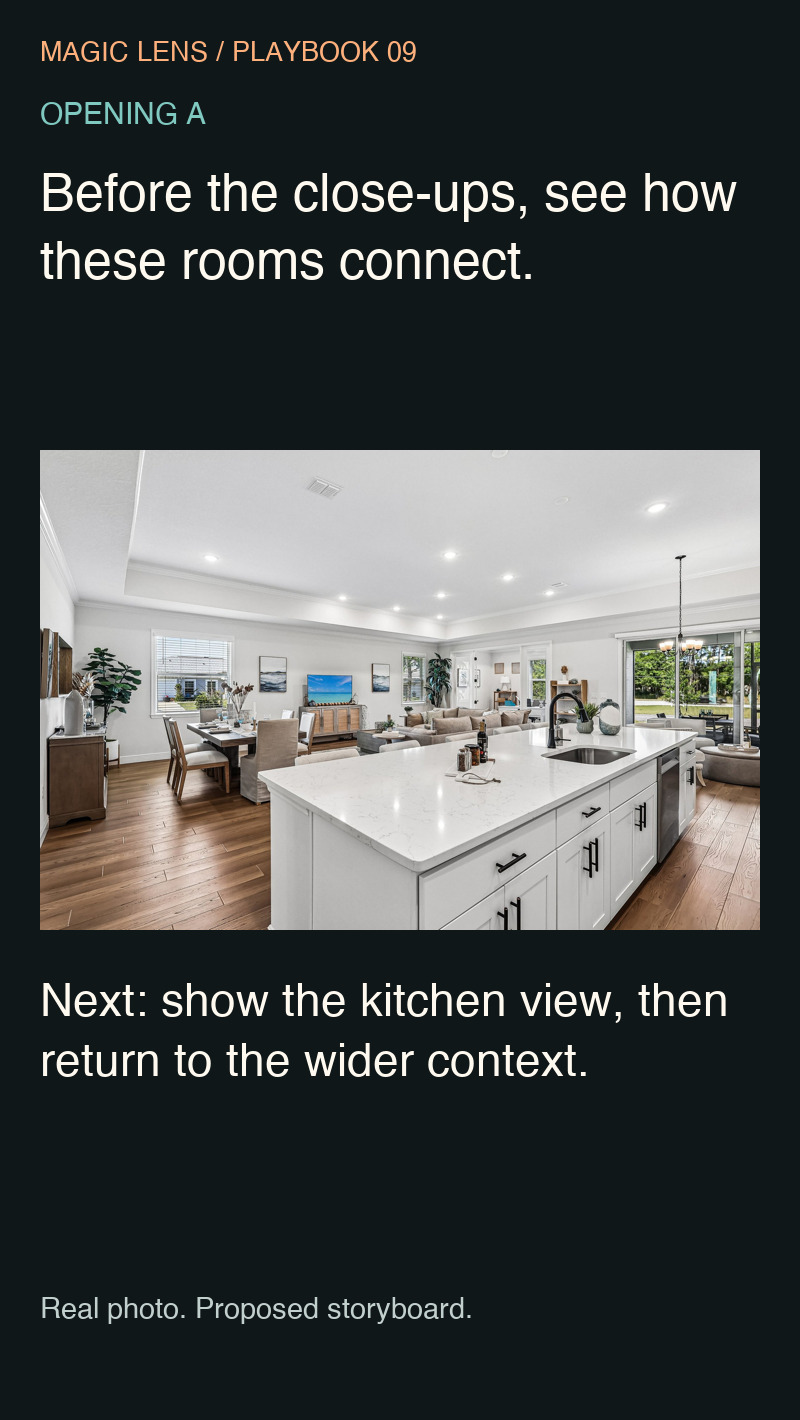
This option gives the viewer a viewing instruction. It also makes the next image meaningful: the detail arrives after the relationship is established. The sequence can fulfill the promise using the material we actually have.
Option B: start with the limitation of a detail
“A kitchen close-up cannot show the whole layout.”
First image: the kitchen-focused view. Continuation: show the wider photograph to add context. Avoid: suggesting that one wide image explains every room or replaces a verified floor plan.
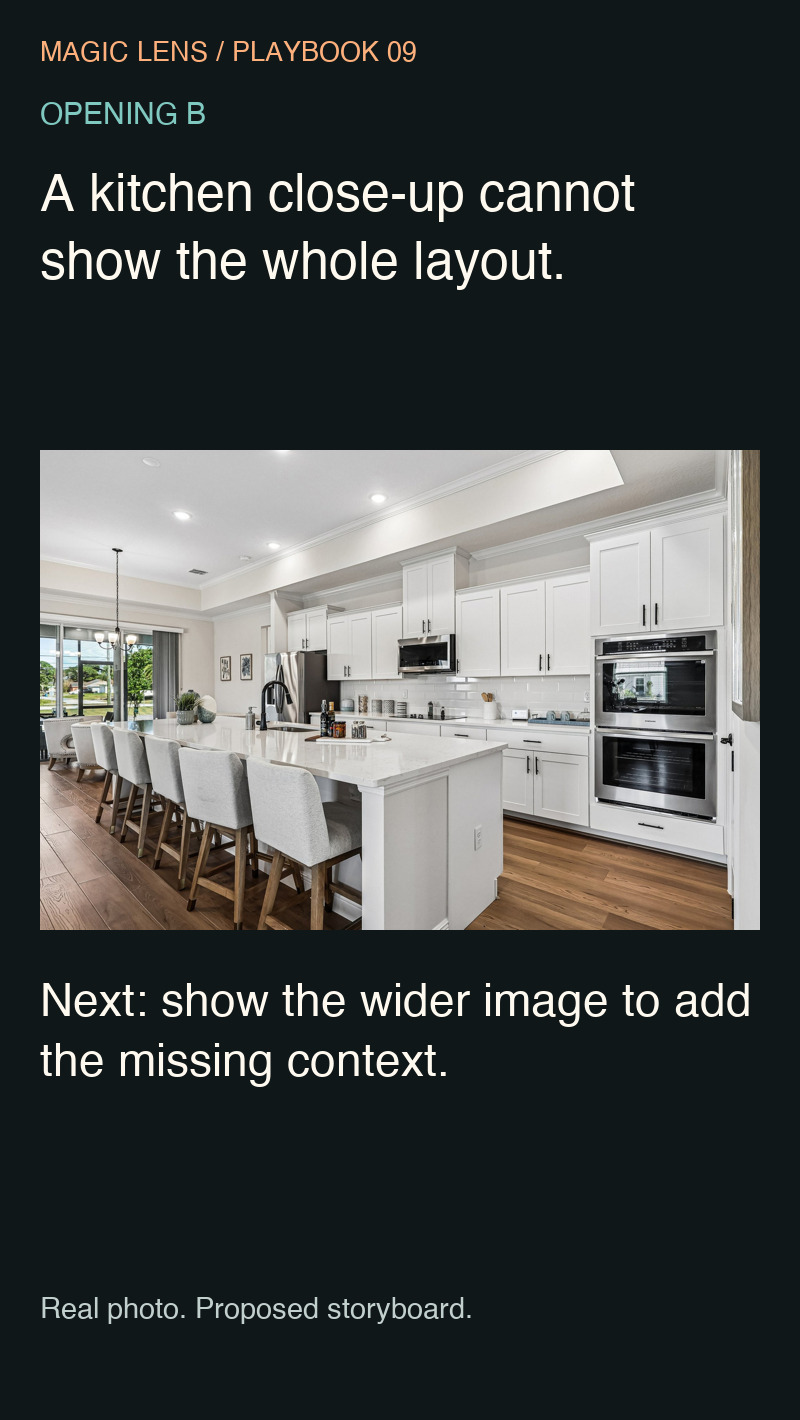
This option works as a small educational contrast. Its risk is spending too much time on the limitation before showing the answer. Keep the explanation concise and make the wider view the clear payoff.
Option C: promise a comparison
“Two views answer different layout questions.”
First image: the kitchen-focused view with a short question about the kitchen. Continuation: the wider view with a question about how the areas relate. Avoid: presenting the two images as a complete property tour.
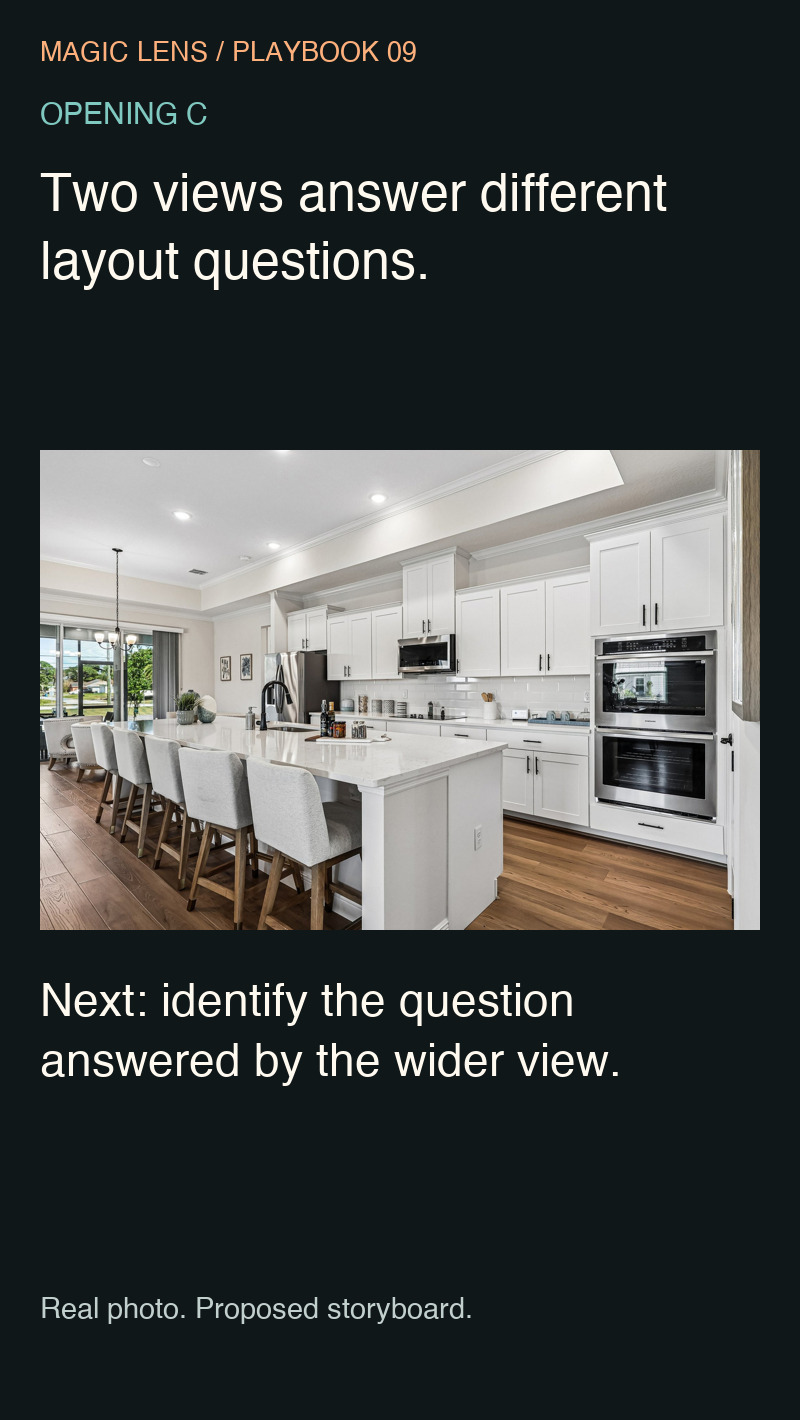
This option needs the questions to be explicit. Without them, the viewer may see only two photographs. A comparison is useful when the difference is explained, not simply because two images appear in succession.
Choose the best fit, not the loudest sentence
For this demonstration, Option A is the clearest fit. It gives the wide image a purpose, creates a natural move toward the kitchen detail and does not require new footage. That is an editorial judgment about the available material, not evidence that it will outperform the other options.
Use three checks when making your own choice. Can the viewer understand the opening without extra context? Does the first image support the words? Can the next scenes deliver the promised explanation? If one answer is no, revise the opening or obtain the missing material.
A complete proposed sequence
The timing below is an editing starting point. Read the text on a phone and adjust the pacing until it is comfortable. No finished video or audience test is claimed.
Scene 1 — proposed 0–4 seconds: wide photograph across the island. Text: “Before the close-ups, see how these rooms connect.” Keep the relationship between the areas visible.
Scene 2 — proposed 4–8 seconds: hold the wide photograph. Text: “Kitchen, living and dining areas in one view.” Let the viewer inspect the image instead of rushing into another transition.
Scene 3 — proposed 8–13 seconds: kitchen-focused photograph. Text: “Now look more closely at the kitchen.” This is the detail promised by the opening.
Scene 4 — proposed 13–18 seconds: return to the wide view. Text: “Use the overview and detail together.” The return connects the two images rather than leaving the kitchen isolated.
Scene 5 — proposed 18–23 seconds: simple end card. Text: “Need to check furniture fit? Verify the dimensions.” This gives a useful next question without pretending the images provide measurements.
Do not crop away the relationship the opening asks the viewer to examine. When adapting a horizontal image to a vertical format, consider a clean frame around the full photograph rather than forcing a tight crop that changes what can be understood. Keep text away from the details it describes.
A still-image sequence does not need artificial camera movement to be useful. Simple holds and clear transitions may serve the explanation. Any motion treatment should preserve the actual property and avoid implying a walkthrough that was never filmed.
A caption that completes the idea
A detail photograph and an overview do different jobs. In this archived Palm Bay model-home example, the wider view helps show the relationship between the kitchen, living and dining areas. The kitchen view adds a closer look.
Use both when you are trying to understand a layout. For questions such as furniture fit, verify the dimensions rather than estimating from a photograph.
Photography: Magic Lens Photo Media. Editorial storyboard example; current listing availability is not represented.
The caption preserves the scope of the images and identifies the example accurately. It does not describe the property as currently for sale or turn the visual lesson into a claim about sales outcomes.
Refine the opening and audit the payoff
Review this proposed opening and sequence: [TEXT].
For each promise in the opening, identify the scene that fulfills it.
Flag any promise without supporting material. Suggest the smallest
wording change that makes the sequence accurate.
This is a more useful revision request than “make the hook stronger.” It asks the model to connect the words to the evidence. If the sequence does not fulfill the promise, more energetic language makes the problem worse.
Shorten the on-screen text while preserving the same meaning.
Use one idea per scene. Do not add urgency, superlatives or facts.
List any wording that may be difficult to read at the proposed pace.
Preview the draft with the sound off, then with any narration. The on-screen sequence should remain understandable. If narration is used, it should clarify the same story rather than introduce a different promise.
Your opening-to-evidence card
ONE IDEA:
OPENING SENTENCE:
FIRST IMAGE:
WHAT THE OPENING PROMISES:
SCENE THAT FULFILLS EACH PROMISE:
AVAILABLE MATERIAL / MISSING MATERIAL:
CLAIMS TO AVOID:
ONE USEFUL NEXT QUESTION:

BEFORE EDITING
[ ] The opening matches the material.
[ ] The first scene makes sense without a long explanation.
[ ] The following scenes deliver the promised idea.
[ ] No unverified property facts or invented footage.
[ ] Text remains readable on a phone.
[ ] The caption identifies the example accurately.
If you are new to video, begin with two permitted photographs and one clear explanation. Sketch the sequence before opening the editing tool. Your next step is not to collect twenty hooks; it is to finish one opening whose promise you can actually keep.
Give the opening something worth showing
You now have an opening whose promise matches its next scene. If the idea is strong but the available images cannot show it, the next decision is a production decision. List the missing view or movement before rewriting the hook again.
Magic Lens can help capture property photography and video around a clear visual purpose. For an upcoming Central Florida listing, review our services and pricing with that missing scene in mind.