
REALTOR AI PLAYBOOK · 12
Better Marketing. Stronger Conversations. Practical AI.
A feature list tells the reader what is present. It does not always explain why the detail deserves attention. “Covered patio” is a fact. “Perfect outdoor living for every season” adds promises the photograph cannot establish.
Take one confirmed feature and complete four lines: what it is, a possible use, the evidence you can show and the next question to verify. That small exercise turns a generic caption into a clearer explanation without inventing benefits.
In this chapter, you will compare three caption styles around a real Magic Lens photograph, use a prompt to develop a more specific version and build a reusable feature-to-evidence card. The aim is to help a reader understand the feature, not tell them that every property fits every need.
A possible use is different from a guaranteed benefit
A covered patio shown with a dining arrangement can support a discussion of outdoor dining. The image does not prove comfort in every weather condition, privacy, usable dimensions or suitability for a particular household. Those are separate questions.
Use conditional, concrete language when the benefit depends on the reader's priorities. “If outdoor dining matters to you, this view helps you examine the patio arrangement” connects the feature to a possible use. It leaves the decision with the reader and points to evidence.
Do not confuse specificity with certainty. A detailed claim can still be invented. “Enough space for twelve guests” is not better than “spacious” if you have no verified dimensions or basis for the statement.
The four-part method
Confirmed feature: name the detail and its source. It may be a verified property record, an approved listing fact or something directly visible in an eligible photograph. Keep those sources distinct.
Possible use: explain a task or activity the feature may support. Avoid claims about who belongs in the property or what lifestyle it guarantees. A possible use should help the reader form a question, not make the decision for them.
Visual evidence: choose an image that actually shows the relevant detail. A close-up may show a finish; a wider view may show the relationship between areas. Neither substitutes for facts it cannot demonstrate.
Next step: identify what the reader can inspect or verify. This may be dimensions, current listing details, included items or a question for the appropriate professional. The next step should follow naturally from the feature.

The real photograph used in this example
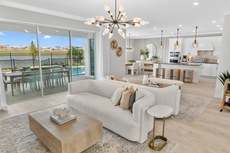
The example is a covered patio from Magic Lens's published Palm Bay model-home photography case. The photograph shows a table and chairs in the covered area. It is an archived portfolio example, not a statement that the property is currently available.
We can use the visible arrangement to explain the difference between description and supported context. We cannot use it to establish dimensions, weather performance, privacy, construction quality or sale inclusions.
Three versions of the same caption
Version 1 — accurate but incomplete
“A covered patio with a table and chairs.”
This describes the photograph. It may be sufficient as a simple image label, but it gives the reader little reason to examine the space. The missing piece is the question the image helps them consider.
Version 2 — inflated and unsupported
“The perfect private retreat for year-round entertaining, with room for everyone.”
Do not use this version. “Private,” “year-round” and “room for everyone” are not established by the image. “Perfect” also hides the fact that suitability depends on the reader's needs. The sentence sounds promotional because it substitutes broad promises for evidence.
Version 3 — specific and useful
“This covered patio is shown with a dining arrangement. If outdoor dining is part of your plans, use this view to examine the setup, then verify the dimensions and current property details that matter to you.”
This version connects a visible feature to a possible use and names the next verification step. It does not claim the furniture is included or that the space meets every need. It gives the photograph a useful role in the conversation.

Ask ChatGPT to stay inside the evidence
Write three caption options about one real estate feature.
Use American English and the facts below only.

CONFIRMED FEATURE: a covered patio in an archived model-home photo.
VISIBLE EVIDENCE: the photograph shows a table and chairs in the
covered area.
POSSIBLE USE TO DISCUSS: outdoor dining.
UNVERIFIED: dimensions, privacy, weather performance, current
availability, furniture inclusion and suitability for a specific person.
NEXT STEP: verify the relevant dimensions and current property details.

For each option:
- Name the feature.
- Connect it to the possible use without guaranteeing suitability.
- Refer to what the image actually shows.
- Give one appropriate next step.

Do not add measurements, construction claims, superlatives or urgency.
Do not describe the archived example as a current listing.
After the captions, identify the evidence behind each factual claim.
The unknowns are as important as the known facts. They tell the model where to stop. If the first output adds a claim such as “low maintenance,” do not accept it because it sounds plausible. Check whether the claim appears in your supplied evidence.
A filled caption for the archived example
A covered patio adds another area to examine in this Palm Bay model-home photography project. The staged dining arrangement shows one way the space was presented for the shoot.
If outdoor dining is a priority, look at the arrangement and identify the dimensions you would need to verify for your own setup. A photograph can help frame that question; it does not answer every detail.
Archived photography example by Magic Lens Photo Media. Current availability and sale inclusions are not represented.
This is an editorial caption example, not a measured marketing result. Its useful distinction is between how a space was presented and what a future user should verify. That distinction helps preserve trust without making the caption unreadably defensive.
Apply the method to other features
Kitchen island: if the photograph shows seating along the island, you can discuss that visible arrangement. A possible use is sitting near the kitchen activity. Do not infer seating capacity, clearance, accessibility or material specifications from appearance alone. Ask which details need verification for the reader's intended use.
Room shown as an office: describe the setup shown in the source material. A possible use to discuss is a separate work area, but do not promise sound isolation, connectivity or legal room classification without evidence. A desk in a photograph does not establish those facts.
Wide interior view: explain the relationship visible between areas. The image may help someone understand the presentation of the layout. It does not prove measurements or how furniture will fit. Use a verified plan or measurements when the question requires them.
These are methods of framing a question, not conclusions about a particular property's suitability. Keep the feature, use and evidence connected every time.
Two refinements that improve accuracy
Audit this caption sentence by sentence. Label each statement as:
directly supported by my facts, a clearly framed possible use,
or unsupported. Remove or flag unsupported claims. Do not replace
them with different invented benefits.
This review helps expose language that entered during rewriting. A model may preserve the main feature while adding a convenient adjective. “Private,” “safe,” “accessible,” “maintenance-free” and similar terms deserve evidence, not intuition.
Make the caption more specific using only the supplied evidence.
Replace vague praise with an observable detail or a useful question.
Keep one next step and preserve the archived-example label.
Do not add facts to make the language sound more persuasive.
Specificity should come from observation and verified context. If the evidence is thin, a shorter caption may be the accurate choice. More words do not create more proof.
Choose the image that answers the question
Match the visual to the point. If the caption discusses a relationship between areas, use an image that preserves that relationship. If it discusses a visible detail, make sure the detail is clear at the size people will see on a phone.
A beautiful crop can become a weak explanation when it removes the relevant context. Review the photograph and caption together. Ask what a reader can actually see, what they might reasonably infer and what the text needs to clarify.
When the available images do not show the feature clearly, plan additional coverage or choose a different angle for the content. Do not use AI to manufacture property characteristics for a stronger story.
Your feature-to-evidence card
FEATURE:
SOURCE OF THE CONFIRMED FACT:
POSSIBLE USE TO DISCUSS:
IMAGE THAT SHOWS THE RELEVANT DETAIL:
WHAT THE IMAGE CANNOT ESTABLISH:
ONE NEXT QUESTION OR VERIFICATION STEP:

CAPTION CHECK
[ ] The feature is confirmed.
[ ] The possible use is not a guarantee.
[ ] The photograph supports the wording.
[ ] No inferred measurements, safety or construction claims.
[ ] Current listing information is verified if included.
[ ] One clear next step follows from the feature.
Choose one feature in your next content brief and complete this card before writing the caption. That gives both the writer and photographer a clearer job: show the evidence the explanation needs.
Capture the evidence your caption needs
You now have a feature, a supported explanation and a useful next question. Check whether the available photograph actually shows the detail you want to discuss. If it does not, another caption is unlikely to close that gap.
Magic Lens can help plan photography around a property’s visual priorities. For an upcoming listing in Orlando or Central Florida, explore our services and pricing and choose the coverage that supports those priorities.