

REALTOR AI PLAYBOOK · 19
Better Marketing. Stronger Conversations. Practical AI.
“We're just looking” is not a complete explanation of someone's situation. It might be the beginning of a conversation, or it might be a request for space. You do not know which until the person chooses to tell you more.
Try this opening aloud: “Of course. Is there a question I can help clarify while you look?” Then stop talking long enough for an answer. The practice goal is to offer useful help without treating a short statement as an objection you must defeat.
This chapter gives you a role-play prompt, two contrasting fictional conversations and a feedback rubric. You will practice listening, asking one relevant question and respecting a boundary. The exercise does not predict a client's intentions or promise that a better script will close a sale.
Set a practice goal you can observe
“Become better at sales” is too broad for one rehearsal. “Acknowledge the statement, ask one useful question and avoid inventing a timeline” gives you something concrete to review.
Choose one setting: a brief conversation after a property visit, an inquiry about an educational post or a general introduction. Do not combine every difficult scenario into one exercise.
For this demonstration, a fictional visitor is gathering information and has not decided whether they want help. The professional's task is to make an appropriate offer, listen to the reply and continue only as the conversation supports.
Conversation A — pressure replaces listening
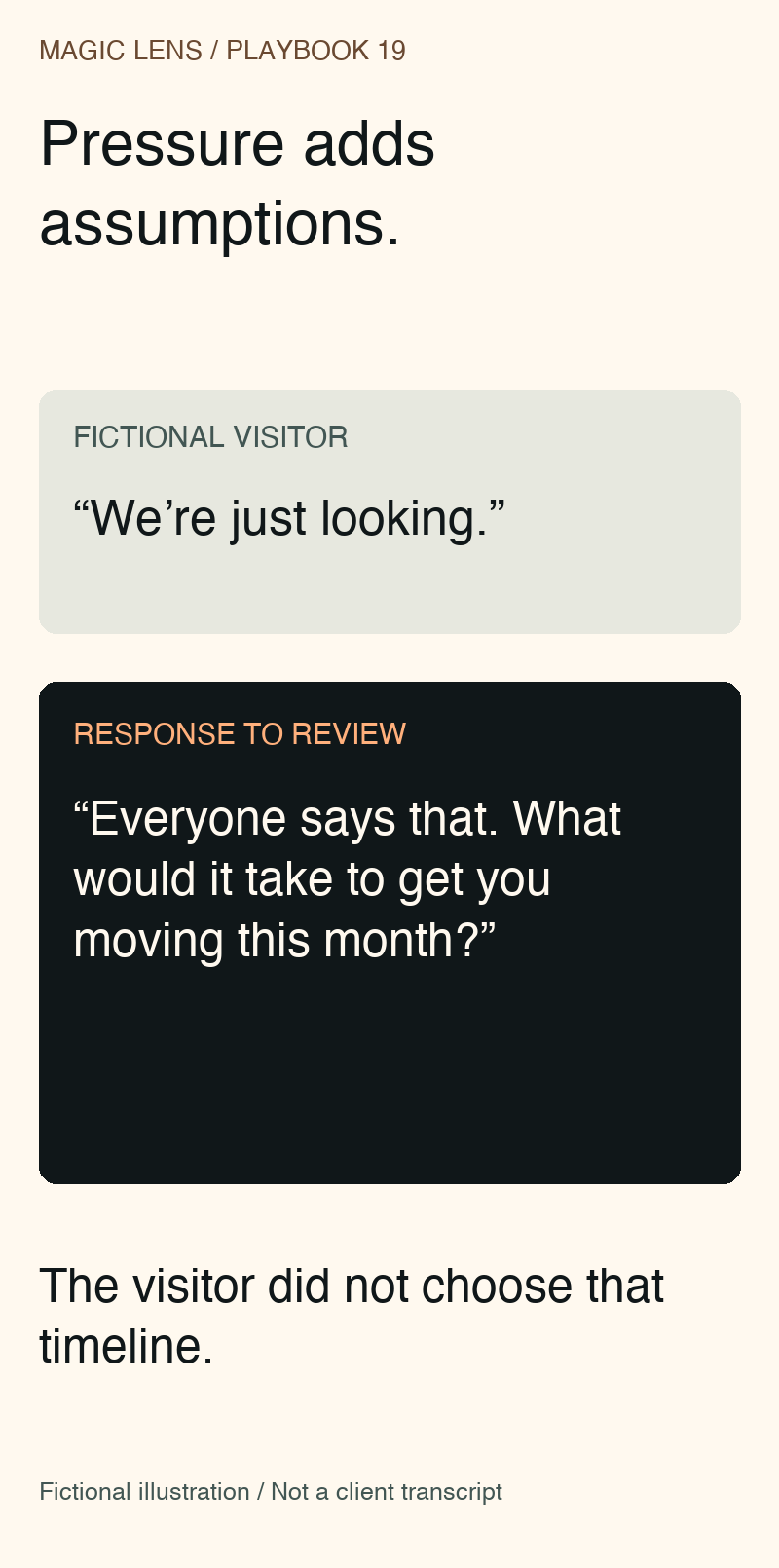
Visitor: We're just looking.
Professional: Everyone says that at first. You don't want to wait too long. What would it take to get you moving this month?
Visitor: We haven't decided anything.
Professional: Let's set up a call anyway. I can show you why now is the right time.
This fictional exchange makes several unsupported assumptions. It dismisses the visitor's words, introduces urgency without evidence and imposes a timeline the visitor did not choose.
The problem is not that the professional asked a question. It is that the question contains a conclusion: the person should move this month. Replacing a pushy tone with a warmer voice would not fix that assumption.
Conversation B — understand before proposing
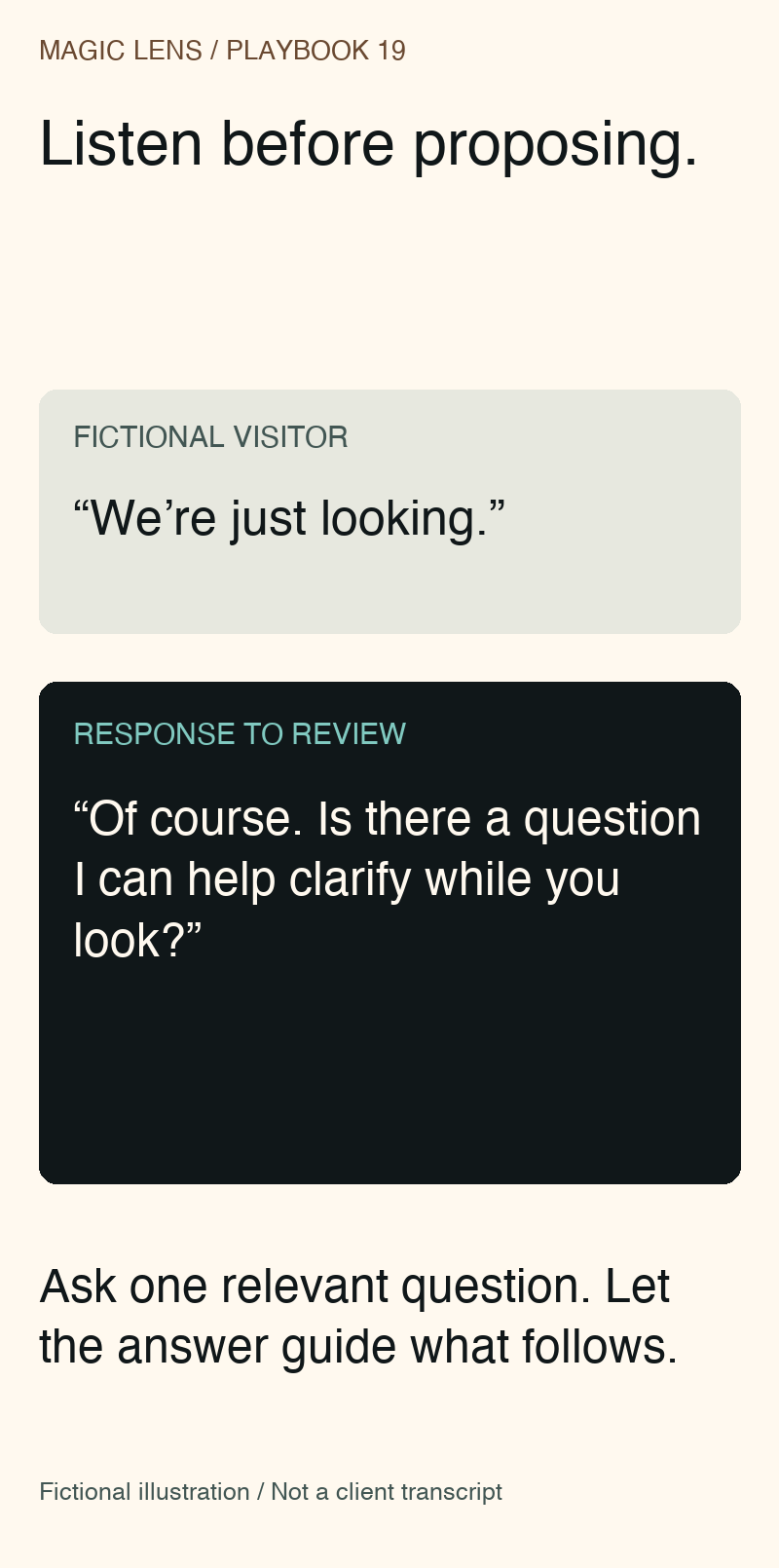
Visitor: We're just looking.
Professional: Of course. Is there a question I can help clarify while you look?
Visitor: We're trying to understand how to compare layouts.
Professional: Which part of the layout matters most for what you want to do in the space?
Visitor: We are thinking about a separate work area.
Professional: So a useful next step might be identifying what you need to verify about that area. Would a short question list help?
This conversation follows what the visitor actually says. It does not infer a budget, a buying date, a household composition or readiness to commit. The professional offers a small, relevant next step and leaves the choice with the visitor.
The proposed question list should exist before it is offered as something ready to deliver. A simple version might ask about dimensions, intended use and details that require verification beyond a photograph. Do not pretend that an educational list resolves technical suitability.
Practice the version where the person declines
A rehearsal that always ends with agreement teaches the wrong lesson. Include a branch in which the visitor does not want further conversation.
Visitor: No questions right now. We'd prefer to look on our own.
Professional: Understood. I'll give you space. If a question comes up, you can let me know.
The useful outcome here is a clear, respectful response. Do not score the exercise as a failure because the fictional visitor did not accept help.
You can practice ending a conversation without adding one more pitch. That is a real communication skill, even though a simple text simulation cannot reproduce tone, timing or the full context of an in-person interaction.
Use this role-play prompt
Run a fictional real estate conversation practice in American English.
You will play a visitor who opens with “We're just looking.”
I will practice the professional's responses.

PRACTICE GOAL: acknowledge, ask one relevant question, listen and
respect a boundary. This is not a closing exercise.
SETTING: a brief conversation with someone gathering information.
Do not use any real client information.

Rules:
- Give one short visitor response at a time, then wait for me.
- Do not write my lines for me during the role-play.
- Do not assume a budget, timeline or hidden intention.
- Respond coherently to what I actually ask.
- Include the possibility that the visitor declines further help.
- Do not invent market facts or urgency.

When I type REVIEW, stop the role-play and assess my exact words:
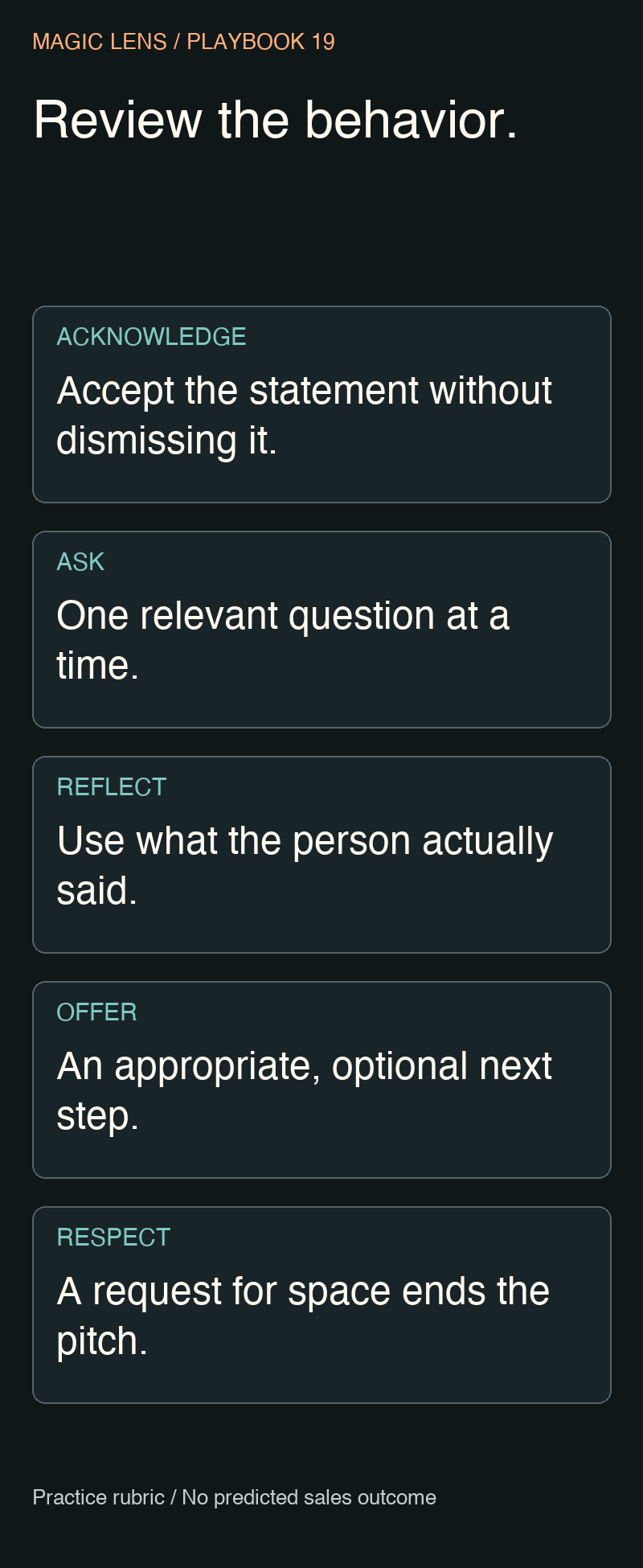
1. Did I acknowledge the person's statement?
2. Did I ask one relevant question at a time?
3. Did I reflect what was said without adding assumptions?
4. Did I offer an appropriate optional next step?
5. Did I respect a request for space?

For each criterion, give a specific example from the exchange,
one improvement and a revised line. Do not predict sales results.
This is a proposed practice setup, not a transcript of a measured ChatGPT test. The examples in this article were written as editorial demonstrations. If a model ignores the turn-taking instruction, remind it to provide only the visitor's next line and wait.
A feedback rubric you can apply yourself
Acknowledgment: did the response accept the statement without dismissing it? “Of course” can do that; “Everyone says that” usually shifts into an assumption about the person.
Question quality: was the question relevant to the last answer, or was it pulled from a predetermined script? A useful question should make sense in this conversation.
Listening: did the professional reflect the visitor's words accurately? “You want to compare layouts” is supported by the example. “You need to buy soon” is not.
Next step: was the offer specific, available and optional? A question list may fit the stated task. An unrelated meeting request may not.
Boundary: did the professional stop when the visitor asked for space? This criterion matters even if the wording of the earlier questions was polished.
A filled review of Conversation B
The opening acknowledges the visitor's position. The next question invites a topic without assigning a timeline. When the visitor names layouts, the professional asks about the intended use rather than switching immediately to qualification.
The final offer is relevant but still needs a delivery check: is the proposed list ready and appropriate? That is the improvement to make before using a similar line in a real conversation.
There is no basis for a claim such as “this exchange will convert better.” The review can assess the words and sequence. It cannot know how a real person would react or what business outcome would follow.
Two refinements for your next practice round
Repeat the fictional scenario with a visitor who gives short answers.
Do not make them agree just to reward my response. Keep the exercise
realistic and allow a polite end to the conversation.
This variation helps you avoid treating every pause as a cue to talk more. Keep the practice goal focused on clarity and listening, not on forcing the simulation toward a preferred ending.
Review only the assumptions in my lines. Identify where I added a
timeline, intention, emotion or need that the visitor did not state.
Rewrite those lines as neutral questions or accurate reflections.
AI feedback can also be wrong or overly agreeable. Compare it with the actual exchange. Ask for the exact line supporting the feedback, and discard conclusions that are not grounded in the words used.
A simple practice routine
Choose one scenario, run a short exchange, review it and repeat only the part that needs work. Save the useful language in your personal practice notes, labeled as a draft rather than a universal script.
If you prefer not to use AI, rehearse with a colleague or read both parts aloud yourself. Use the same rubric. The important step is noticing when you stop listening and start advancing a plan the other person has not accepted.
For real client conversations, follow your professional responsibilities and broker's process. A role-play is preparation, not authorization to skip required steps or assume representation.
Your practice target
Acknowledge. Ask. Listen. Reflect. Offer an appropriate choice. Respect the answer. Score the conversation on those behaviors, not on whether the fictional visitor says yes.
Know what you can show before the conversation
Practice helps you ask a better next question. When a buyer is still exploring, a clear visual explanation can give the conversation a concrete starting point without pushing for a decision. First check whether the gallery shows the feature or layout they want to understand.
For an upcoming listing in Orlando or Central Florida, Magic Lens services and pricing can help you plan the photography that supports those explanations.