

REALTOR AI PLAYBOOK · 06
Better Marketing. Stronger Conversations. Practical AI.
Your bio says you work in real estate. A visitor still has to guess where you work, what they will learn from following you and what to do next. Adding “passionate,” “dedicated” or another house emoji does not answer those questions.
Open a blank note and complete three sentences: I work in this area. This profile helps people understand this. The next useful step is this. Use facts you can support today. If a sentence depends on a future resource or experience you do not have, revise it.
That is the foundation for a clearer bio. In this chapter, you will build a compact bio, a short introduction and one specific next step. You will also learn to check whether the rest of the profile supports what those few lines promise.
Separate your profession from your usefulness
A professional title tells people what you do. It does not explain what your content does for them. “Real estate agent in Orlando” establishes a role and region. “Practical explanations of showing preparation and listing media” describes a reason to spend time on the profile.
You do not need to claim a unique secret. You need to make a useful promise you can keep. A clear explanation of what to bring to a consultation may be more credible than a claim to deliver an “unmatched real estate experience.”
Keep your geographic scope accurate. If you serve a specific area, name it in language the intended visitor understands. Do not list every nearby city merely to look larger. The same principle applies to specialties: interest in a topic is not evidence of expertise.
Use the professional title, brokerage identification and other disclosures required by your actual status and approved process. Have those requirements checked through your brokerage before changing a live profile. This writing exercise does not determine which titles or disclosures you are entitled or required to use.
Choose evidence before adjectives
Make a list of things a visitor can actually inspect: a preparation checklist you created, a clearly explained process, a permitted case study, a useful introduction or a set of educational posts. These can support your profile's promise without inventing awards, years in business or transaction counts.
If you are new, your evidence may be the quality of your explanations and the consistency of your process. Show the questions you help people clarify. You can say you explain the steps in a consultation if you actually publish that explanation. You cannot turn an aspiration into a record of completed work.
Separate evidence from decoration. A professional portrait can make a profile recognizable. It does not prove a claim about results. A statement such as “clear preparation guidance” becomes more credible when the visitor can find and read that guidance.
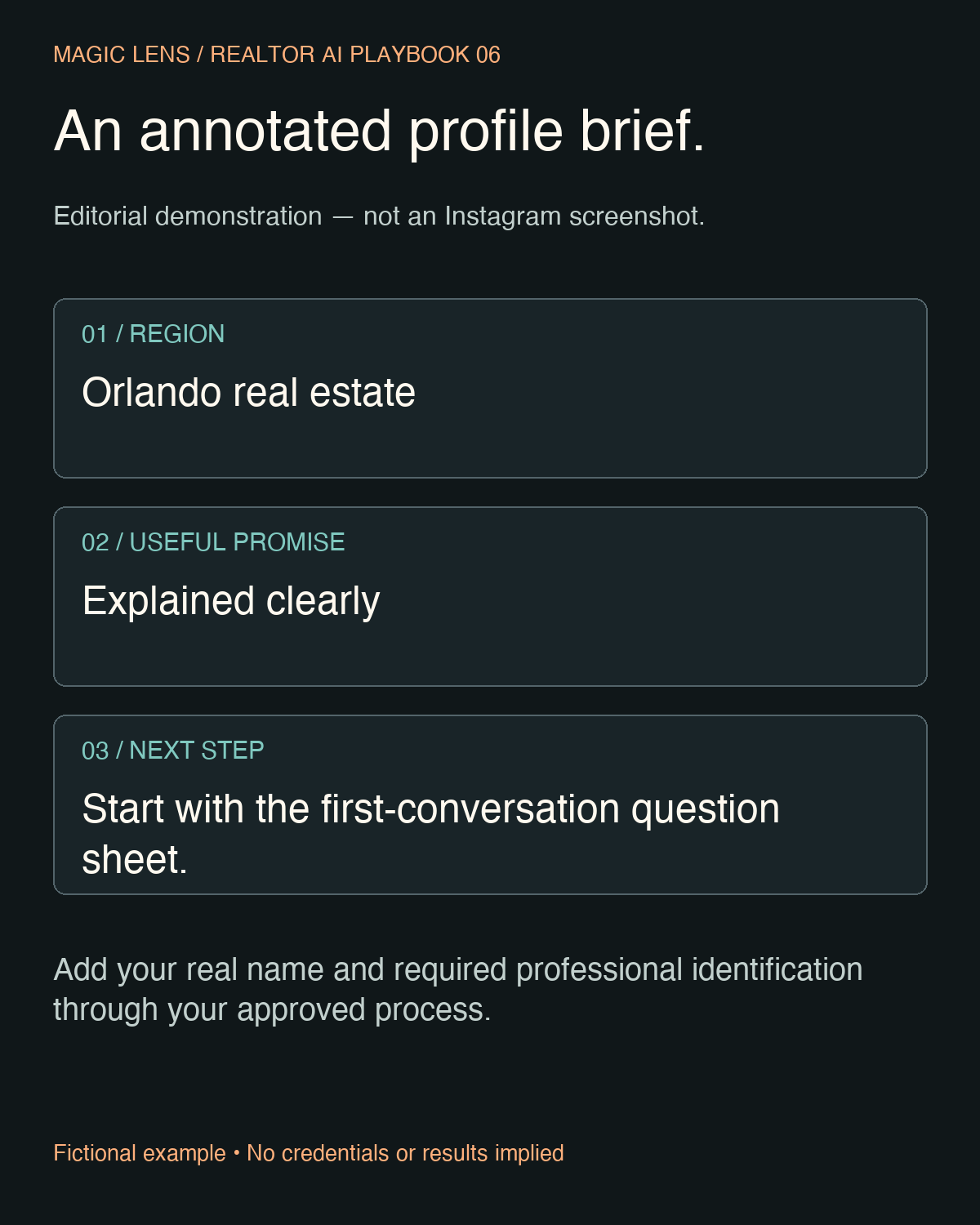
A fictional profile brief
Role and area: a fictional real estate agent serving Orlando. Actual professional identification would be inserted and reviewed separately.
Content focus: practical explanations of buyer preparation, seller preparation and the questions to clarify before an appointment.
Available evidence: an original, completed first-conversation question sheet and three educational posts explaining how to use it.
Next step: open the existing question sheet through the profile's verified link.
Not supplied: awards, sales volume, years of experience, testimonials or claims of superior results. The draft must not add them.
This is a constructed teaching example, not a real agent profile. The question sheet is assumed to exist within the fictional scenario so you can see how the pieces connect. In your own profile, use only a resource that is already complete and accessible.
Use this prompt to draft the three pieces together
Help me clarify a real estate profile in American English.
Use only the verified facts in my brief.

ROLE + APPROVED PROFESSIONAL IDENTIFICATION: [FACTS]
AREA I ACTUALLY SERVE: [AREA]
WHAT MY CONTENT HELPS PEOPLE UNDERSTAND: [SPECIFIC TOPICS]
EVIDENCE A VISITOR CAN INSPECT: [EXISTING RESOURCES OR WORK]
ONE AVAILABLE NEXT STEP: [ACTION + VERIFIED DESTINATION]
VOICE: clear, warm, practical; no inflated claims.

Return:
1. Three compact bio options, each under 125 characters for this
   writing exercise. Count characters, including spaces.
2. A short introduction of 60–90 words that supports the same idea.
3. One specific next-step instruction.
4. A claim check identifying the supplied fact behind each claim.

Do not invent experience, credentials, testimonials or results.
Do not remove required identification to meet the writing limit.
If the supplied information cannot fit, explain the conflict.
Treat the character target as an editing constraint, not a claim
about the platform's current field limits.
The three pieces should form one coherent introduction. If the bio promises useful preparation guidance but the introduction talks only about ambition and passion, the profile is sending two different messages.
Before and after: give the visitor a job to do
A vague starting point might read: “Passionate about homes. Dedicated to your dreams. Contact me for all your real estate needs.” The words could belong to almost anyone and do not tell the visitor where to begin.
For the fictional brief, these are more specific draft options. They exclude any professional identification that must be handled separately and should be tested against the actual available space before use.
Option A: Orlando real estate, explained clearly. Start with the first-conversation question sheet.
Option B: Preparing to buy or sell in Orlando? Bring better questions to your first conversation.
Option C: Orlando home buying and selling preparation. Read the question sheet before we talk.
Option A emphasizes the profile's teaching role. Option B speaks to a visitor's immediate task. Option C is direct about preparation. None claims to be the best agent, guarantees a result or borrows credibility from a fictional sales record.
Choose based on what the visitor will find after clicking, not on which version sounds most impressive in isolation. If the resource is not actually available, replace the call to action with a useful step you can deliver now.
The introduction that supports the bio
Buying or selling begins with questions, and clear answers take context. This profile focuses on practical preparation for real estate conversations in Orlando: what to ask, what to gather and which details still need to be verified. Start with the first-conversation question sheet, then bring the questions that apply to your situation. The educational posts here explain the process; your specific property, timing and priorities need an individual conversation.
This fictional introduction explains the purpose of the content and its limits. It is not a substitute for the agent's real name, professional identification or brokerage information. Add accurate required details through your approved process.
The matching next-step instruction is simple: “Open the first-conversation question sheet, then choose the three questions you want to discuss.” It gives the reader an action and a reason for taking it. “Click the link” describes the mechanism but not the value.
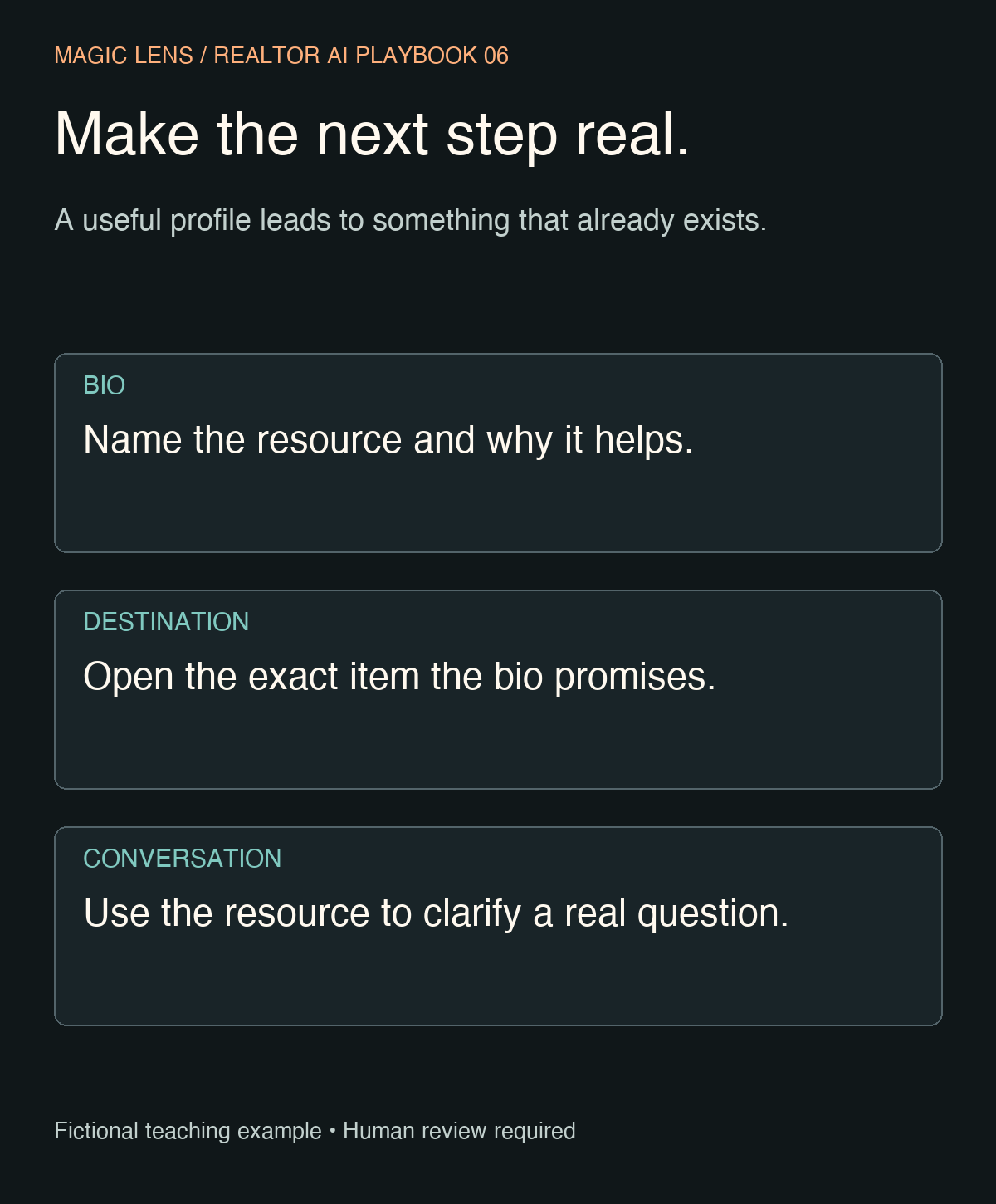
Make the destination match the promise
Follow the path yourself as a visitor. Does the link open the named resource? Is its title recognizable? Can someone understand it without sending private information first? If the link opens a general homepage with no obvious route to the sheet, the bio is creating extra work.
Check this on a phone, where the profile will often be viewed. Read the bio without relying on a large desktop display. Open the destination, inspect the first screen and confirm that the promised item is easy to find. This is a usability check, not a prediction about follower growth.
If the next step is a message, make the request specific and realistic. “Message me with the preparation question you want to clarify” is clearer than “DM me.” Do not promise an instant answer, automated delivery or a free resource unless those things are actually in place.
Refine for clarity, then for fit
Compare these bio options against my brief. For each, tell me:
- What does a visitor learn about the region?
- What useful content should they expect?
- What is the next action?
- Which claim lacks evidence?
Recommend the clearest option without adding new claims.
Do that review before shortening. A vague message can become even less useful when compressed. Once the meaning is right, adapt it to the space you actually have in the current profile editor, including any required identification.
Shorten this approved bio to [MY AVAILABLE CHARACTER BUDGET].
Preserve the region, useful promise and one next step.
Keep this required identification unchanged: [TEXT].
Count all characters, including spaces and line breaks.
If everything cannot fit, explain what needs a separate approved
field instead of silently removing a requirement.
Verify the final count in the actual editor. Character counting can differ when special symbols or line breaks are involved, and a model's count should not be the final authority.
Your profile clarity card
ROLE + REQUIRED IDENTIFICATION:
ACCURATE SERVICE AREA:
USEFUL CONTENT PROMISE:
VISIBLE EVIDENCE:
ONE NEXT STEP:
DESTINATION CHECKED ON PHONE:

FINAL REVIEW
[ ] The bio matches my real role and region.
[ ] Every claim has support.
[ ] The introduction explains what visitors will find.
[ ] The promised resource already exists.
[ ] The link and destination match the wording.
[ ] Required professional details remain accurate and visible.
If you have no resource yet, begin with a truthful introduction and one educational post answering a common process question. Do not announce a library you plan to build someday. Improve the destination first, then let the bio point to something worth opening.
Your next step is to complete this card and compare it with your current profile. Change the weakest connection: an unclear area, an unsupported claim or a vague next action. A useful profile is a connected path from recognition to understanding to a real conversation.
Check what visitors see after the bio
Your bio now gives people a reason to stay. Look at the posts immediately below it: do they demonstrate the care and clarity you just described? A stronger introduction cannot fill gaps in the property images a visitor uses to judge your presentation.
For your next Central Florida listing, Magic Lens provides photography and visual media you can plan around the property’s story. Explore our services and pricing to decide what belongs in that plan.