

REALTOR AI PLAYBOOK · 22
Better Marketing. Stronger Conversations. Practical AI.
“Another agent charges less” is a request for clarity before it is an invitation to defend yourself. The person may be comparing costs, questioning the scope or deciding which responsibilities matter. You do not know which until you ask.
Start with this: “I understand that cost matters. Would it help if I walked you through my proposed responsibilities and deliverables, so you can decide whether they fit what you need?” Then show the actual scope. Do not answer a price question by making unsupported claims about someone else's service.
This chapter gives you a responsibility matrix, a short response and a ChatGPT prompt for making your explanation clearer. The examples are fictional communication exercises. They do not establish a fee, a service policy or a recommendation about what any professional should charge.
Explain your offer before defending its value
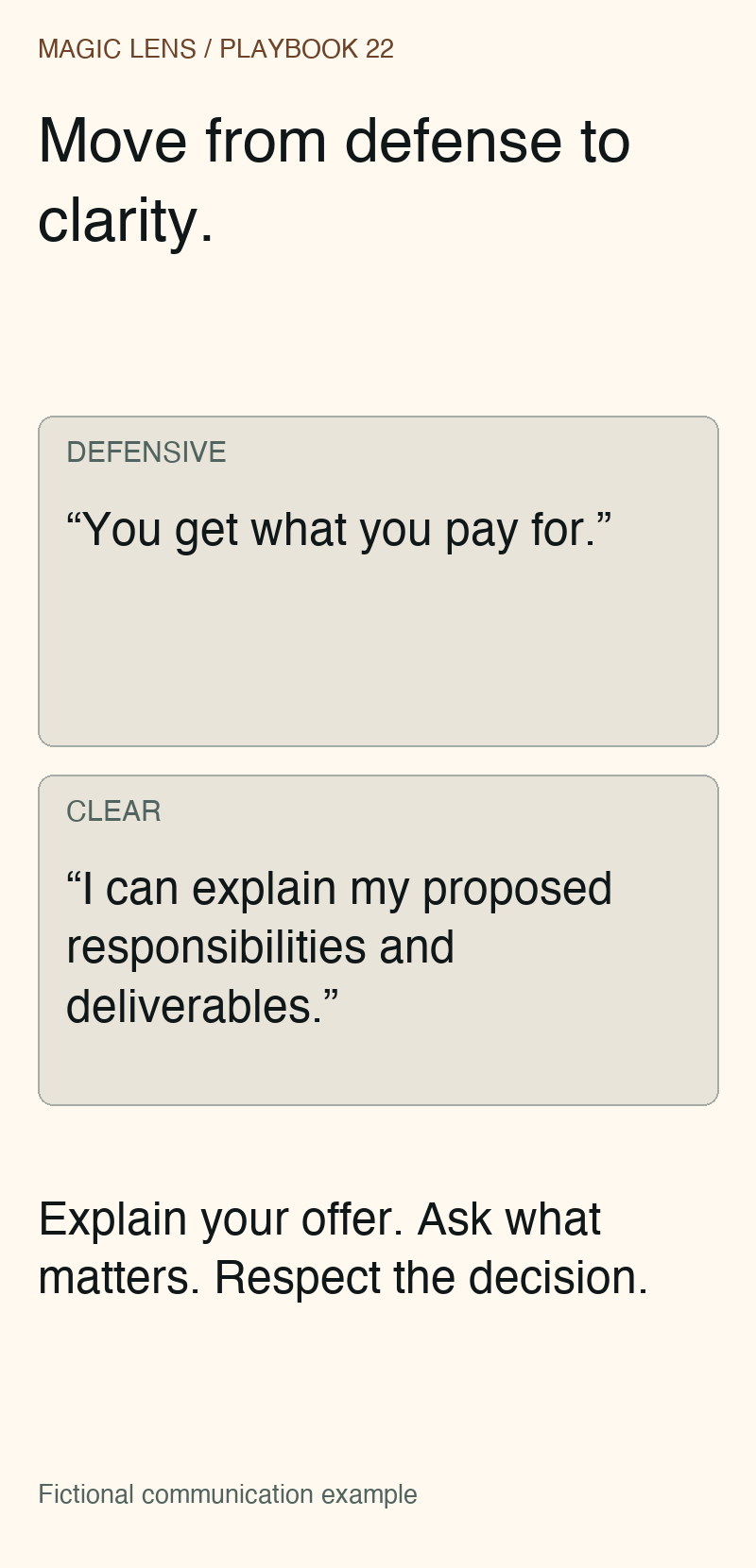
“You get what you pay for” sounds decisive, but it tells a prospective client very little. It also implies that a lower price proves lower quality. You cannot establish that from the quoted amount alone.
“I work harder” has the same weakness. The client cannot inspect effort that has not been defined. Instead, name the work, explain why it matters to this assignment and show how the client will recognize that it has been done.
Keep the conversation about your own proposal. If the person wants to compare two offers, encourage them to review each offer's actual written scope and ask the provider to clarify anything missing. An empty field means “not yet confirmed,” not “the other agent does not do this.”
One useful distinction
A statement about your own documented work is evidence you can explain. A guess about a competitor is still a guess, even when ChatGPT makes it sound polished.
Before and after: the defensive answer
Before: “Cheap agents cut corners. My marketing will get you more money, so the fee pays for itself.”
That answer combines an unsupported accusation with an outcome promise. Neither helps the person understand the proposed work.
After, in a fictional seller conversation: “I can't speak for another professional's proposal. In mine, I would coordinate the preparation brief, organize the agreed media, review the listing materials with you and provide the updates described in our proposal. I can show you those deliverables and confirm what is included before you decide.”
Use that wording only if those responsibilities are actually part of your offer. The better answer is not a script that creates new obligations. It is a structure for explaining obligations you are prepared and authorized to make.
Build a matrix of your own responsibilities
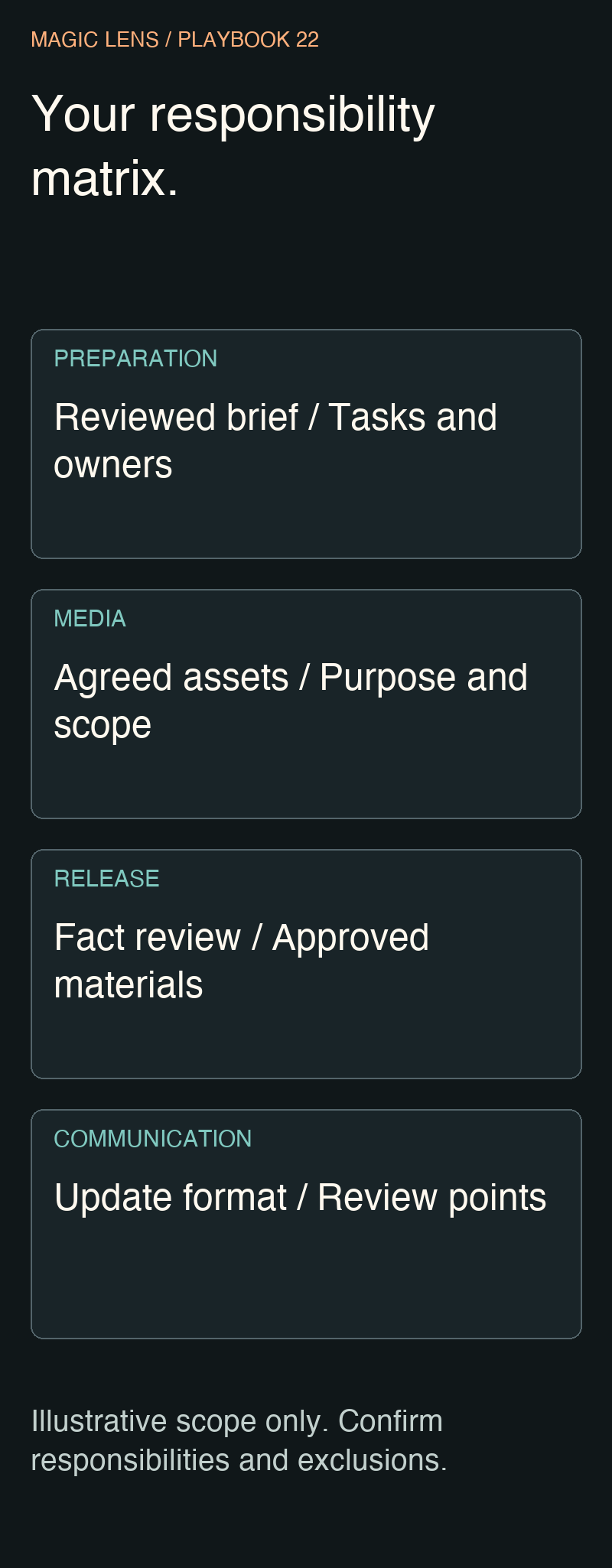
Make one row for each meaningful part of the assignment. Use four fields: responsibility, visible deliverable, client participation and scope status. Keep internal tasks that do not affect the client's decision out of the first conversation.
Preparation coordination: a reviewed readiness brief; the seller confirms access and agreed preparation tasks; the exact scope is pending confirmation. This does not automatically include cleaning, repairs or staging.
Media coordination: the agreed visual assets and a review of how they will be used; the seller and relevant professionals provide the inputs required; formats, rights and delivery details follow the actual agreement.
Listing-material review: an accuracy checklist and approved presentation; the seller helps resolve factual questions; the publication channels and approval process must be specified.
Communication: the update format and review points stated in the proposal; the client identifies useful questions and communication preferences; do not invent a response-time guarantee to make this row sound stronger.
These are illustrative rows, not a universal service package. Replace them with your own approved scope. Add a separate “not included” or “requires a separate agreement” note when that distinction would otherwise be unclear.
Let the client identify what matters
After explaining the matrix, ask one focused question: “Which of these responsibilities is most important to you, and which needs more explanation?” That gives the next part of the conversation a purpose.
If the person asks for a lower cost, acknowledge the question directly. Review any available options through your own authorized process. Do not imply that a market-wide fee exists or that other professionals must charge the same amount.
If there is no acceptable arrangement, a respectful ending is better than pressure. “I understand. If this proposal does not fit your priorities, you should choose the arrangement that does” leaves the decision with the client.
This communication exercise does not decide contract terms. For context, NAR's consumer guidance on negotiating written buyer agreements explains that services and compensation are negotiable and that compensation is not established by law. The guidance concerns buyer agreements; it is not a substitute for reviewing the actual agreement and applicable requirements.
Give ChatGPT facts it can organize
Do not ask the model to “prove I'm worth more.” That framing encourages an impressive argument without an evidence requirement. Give it a factual description of your own proposed scope and ask for a clear explanation.
Use a sanitized summary rather than uploading a client's private agreement, another professional's confidential proposal or sensitive transaction details. For a practice exercise, fictional roles and public business information are enough.
Help me explain my own real estate service proposal in American English.
The prospective client said: "Another agent charges less."

Use only the scope facts I provide below. Do not invent missing services.
For this fictional exercise, the proposed responsibilities are:
- Coordinate a preparation brief, with readiness tasks assigned.
- Organize the agreed visual media and its intended use.
- Review listing facts and materials before release.
- Provide the communication format and review points in the proposal.
Exact scope and commitments still require confirmation.

Produce:
1. A calm opening of no more than 60 words.
2. A four-row matrix: responsibility, deliverable, client input, status.
3. One question that helps the client identify what matters to them.
4. A respectful response if the proposal is not a fit.

Do not criticize competitors, infer their service quality, set a fee,
suggest a standard industry rate, promise a sale outcome or imply that
marketing pays for itself. Do not provide individualized legal advice.
Label the output as a fictional communication example.
A filled response you can adapt
Fictional opening: “I understand that cost is part of your decision. I can explain the responsibilities and materials in my proposal, including what is still subject to confirmation. Then you can decide whether that scope matches what you want.”
Scope explanation: “The preparation brief defines what needs to be ready and who handles each task. The media plan explains what the agreed visuals need to show. The review step checks the facts before release. The communication plan defines the updates we agree to provide.”
Useful question: “Which part of that process would you like to examine more closely?”
If it is not a fit: “Thank you for being clear about your priorities. I can confirm the options I am authorized to offer, but I do not want you to feel pressured into a scope that does not work for you.”
Notice what the example does not establish: an agreed price, a competitor's omissions, a signed commitment or a sale result. It makes the conversation inspectable without pretending the decision has already been made.
Two refinements that improve the answer
Audit the response for unsupported claims. For each sentence, identify
the scope fact that supports it. If none exists, flag it for removal
or confirmation. Pay special attention to implied guarantees,
competitor comparisons and promises about availability.
This first pass checks substance. A softer tone cannot repair a false claim. Resolve the unsupported statement before polishing its wording.
Shorten the opening to a natural spoken answer. Keep the acknowledgment,
the offer to explain my own scope and one useful question. Remove
defensive language. Do not add discounts, commitments or assumptions.
The second pass checks delivery. Read the answer aloud. If you would not say it to a real person across a table, simplify it. A clear two-sentence opening is usually more useful than a memorized speech.
Your next action: prepare one evidence card
RESPONSIBILITY I AM PROPOSING:
WHY IT MATTERS TO THIS ASSIGNMENT:
DELIVERABLE THE CLIENT CAN INSPECT:
CLIENT PARTICIPATION:
SCOPE STATUS: proposed / confirmed / outside scope.
QUESTION STILL TO RESOLVE:
Complete one card using a real, approved responsibility. You can do this on paper without ChatGPT. Check it against your proposal, then practice explaining it without mentioning another agent.
The goal is not to win every price conversation. It is to help the person understand your offer accurately and decide whether it fits. If the explanation reveals that your own deliverables are vague, strengthen the proposal before looking for a more persuasive script.
Put a clear scope behind the value conversation
You now have a way to explain your work without attacking another professional. Apply that same clarity to the media you propose: what will be captured, why it matters for this property and which deliverables are included. Keep your brokerage compensation discussion separate from the cost of media production.
For a Central Florida listing, Magic Lens services and pricing can help you define that production scope before discussing it with the seller.