

REALTOR AI PLAYBOOK · 17
Better Marketing. Stronger Conversations. Practical AI.
“Is it still available?” is a request for information. Your first reply should address that request before turning into an interview about the buyer's finances, timeline and entire search history.
Before drafting, choose the correct branch: current status verified, status still being checked or no longer available for the requested next step. If you cannot select a branch from current information, do not let ChatGPT select one for you.
This chapter gives you three fictional conversations, a status card and a prompt for writing a clear first response. The examples demonstrate wording, not the availability of any real property. No messages are sent and no visits are scheduled by this article.
Answer the question you actually received
A short inquiry is not proof that the person is serious, unserious, qualified or unqualified. It is simply a short inquiry. Do not fill the missing context with assumptions.
The immediate task is to identify the property, verify the relevant status and explain a reasonable next step. If the original message does not identify the property, ask for the listing link or another appropriate reference before discussing details.
Use the current information and procedures available through your professional workflow. A social post, an old screenshot or a remembered conversation may be out of date. ChatGPT is a drafting aid; it does not independently establish whether a property can be shown or what conditions apply.
Build a status card before the reply
PROPERTY REFERENCE: identify it in your approved internal workflow.
QUESTION RECEIVED: what does the person want to know?
STATUS CHECKED: yes / still checking.
SOURCE AND TIME OF CHECK: record internally.
WHAT IS CONFIRMED: the exact fact you may communicate.
WHAT IS NOT CONFIRMED: access, appointment time or other details.
NEXT STEP: one action appropriate to the current situation.
Keep private client information out of generic AI prompts. You can draft with “the property in the inquiry” and a non-sensitive status summary. The model does not need an access code, the seller's schedule or a buyer's financial documents to improve a sentence.
Before and after: a first reply
Before: “Yes! What's your budget, are you preapproved, when are you moving and can we hop on a call today?”
This reply bundles several questions, assumes a “yes” is supported and skips the distinction between current listing status and a confirmed showing. The information may matter later, but it does not all belong in the first sentence.
After, when supported: “I checked the current information, and the property is available for showing requests. What day are you considering? I will confirm the showing arrangements before confirming a time.”
The improved version answers, asks one relevant question and preserves the confirmation step. Use it only if its facts match the actual situation and your approved process.
Scenario 1 — current status verified
Fictional facts: the professional has checked current information and confirmed that showing requests can be considered. No appointment has been confirmed.
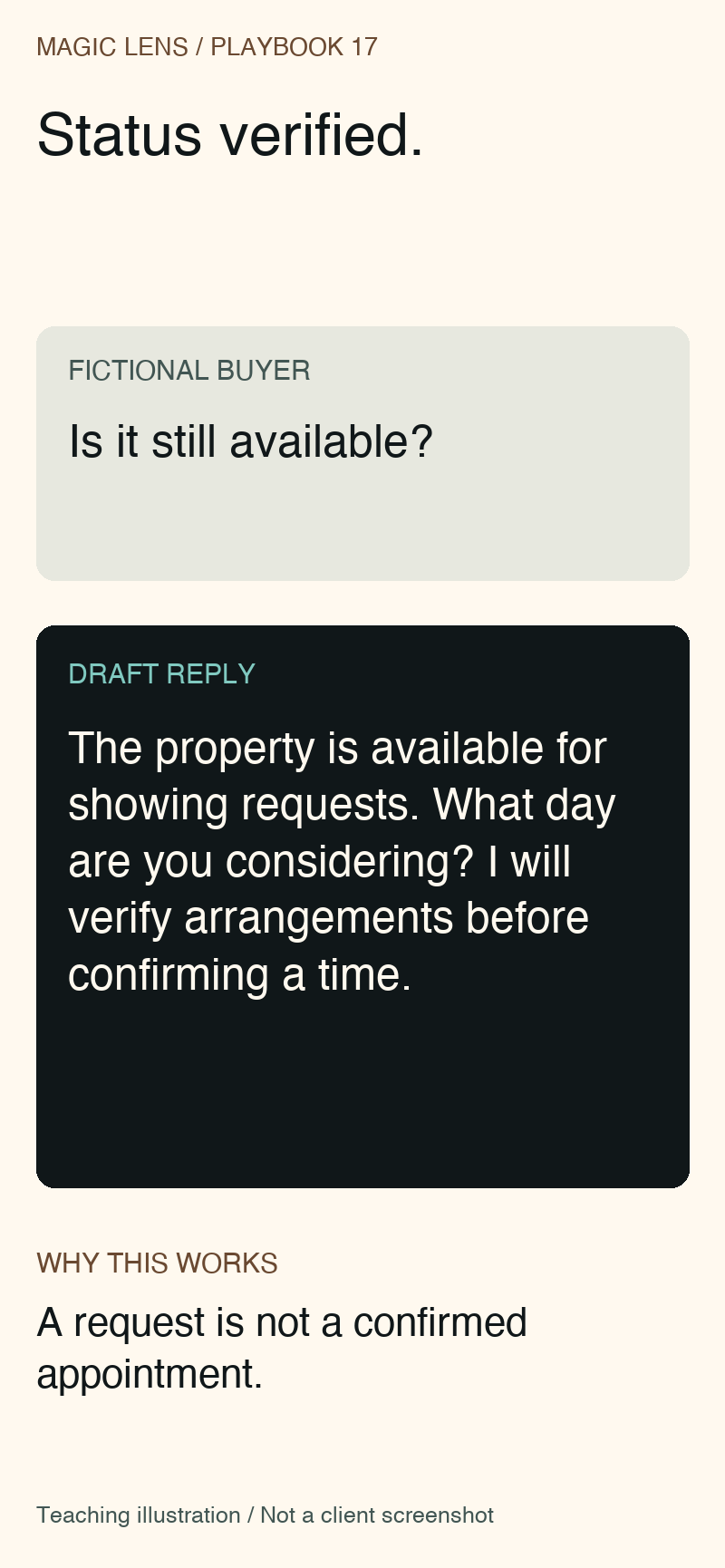
Buyer: Is it still available?
Professional: I checked the current information, and the property is available for showing requests. What day are you considering? I will verify the arrangements before confirming a time.
Buyer: Saturday afternoon.
Professional: Thanks. I will check that request through the showing process and let you know what can be confirmed.
The last reply does not say “See you Saturday.” A preferred day is an input to the process, not an appointment. Follow the actual requirements of the listing and your professional workflow before making a commitment.
Scenario 2 — you are still checking
Fictional facts: the inquiry identifies the property, but the professional has not yet verified current status.
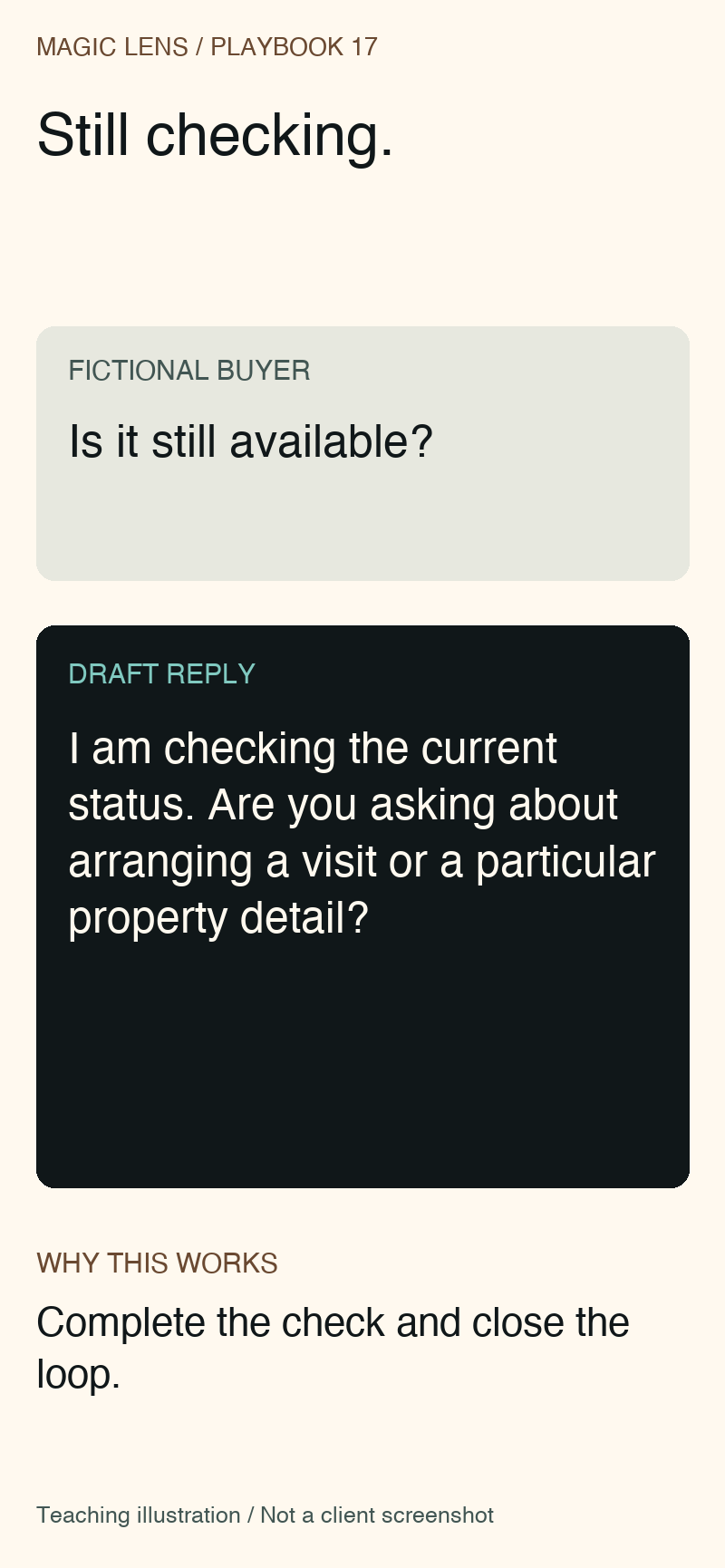
Buyer: Is it still available?
Professional: I am checking the current status so I can give you an accurate answer. Are you asking about arranging a visit or a particular property detail?
Buyer: A visit.
Professional: Understood. I will verify the status and showing process before suggesting a next step.
This is an honest holding response. It should not become an excuse to leave the question unresolved. Record the verification task in your approved workflow, complete it and send the factual answer when available.
If you promise a specific update time, make sure you can keep it. The sample deliberately does not invent a two-minute or same-day guarantee.
Scenario 3 — the requested next step is unavailable
Fictional facts: current information confirms that new showing requests are not being accepted. The example does not assume a sale, contract term or reason that has not been verified.
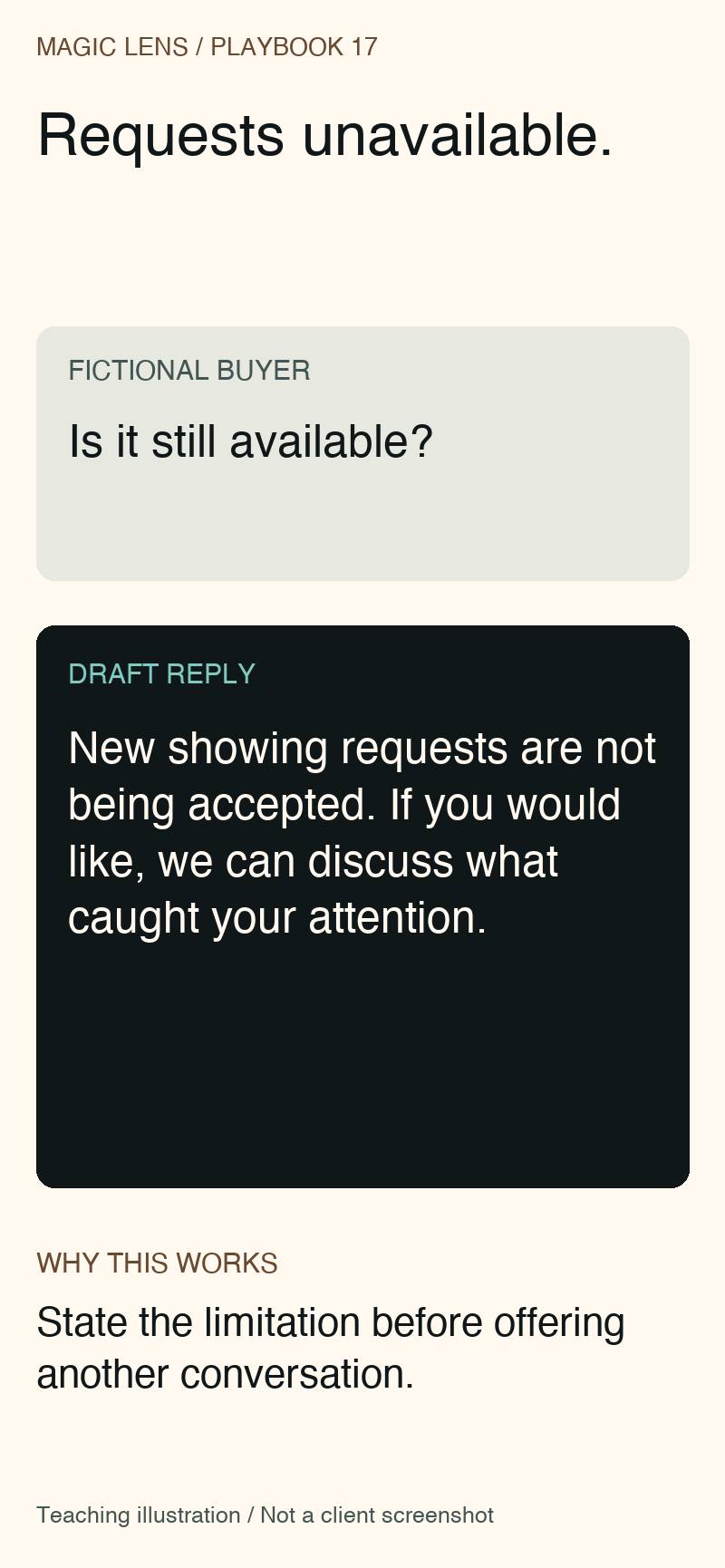
Buyer: Is it still available?
Professional: I checked, and new showing requests are not being accepted for this property. If you would like, we can discuss what caught your attention so I understand what you are looking for.
Buyer: The layout.
Professional: Which part of the layout was useful to you?
The reply states the known limitation first. It then offers an optional conversation rather than using the outdated property as bait for an unrelated pitch. If a different verified status is appropriate to communicate, use that exact status instead.
Use ChatGPT after you choose the branch
Draft a first reply to a real estate inquiry in American English.
Use only my verified facts. Do not determine property status.

INQUIRY: “Is it still available?”
BRANCH: current information verified; showing requests may be made.
CONFIRMED: the professional has checked the current information.
NOT CONFIRMED: a showing appointment, access or a specific time.
NEXT STEP: ask which day the person is considering, then check
the request through the actual showing process.

Write a reply under 60 words. Answer the inquiry, ask no more than
one useful question and preserve the confirmation step.
Do not invent urgency, competing offers, deadlines or availability.
Do not request financial documents or private access information.
After the reply, list the facts that require my final review.
For the second or third scenario, change the branch and facts before generating the reply. Do not reuse the first prompt and hope the model notices a different situation elsewhere in the conversation.
A filled review of the first scenario
Claim: showing requests may be made. Basis: the fictional professional has checked the current information. Question: which day the buyer is considering. Unconfirmed item: the appointment itself. Human action: follow the showing process and confirm only what is actually approved.
This review is intentionally simple. If you cannot connect a statement in the draft to a supplied fact, remove it or investigate. “There is a lot of interest” is not a harmless flourish when you have no evidence for it.
Two refinements for a better reply
Audit this reply for implied certainty. Identify any sentence that
turns a request into an appointment, an old fact into a current fact
or an unknown into a promise. Rewrite using only the verified status.
Pay attention to small words. “You can see it Saturday” is stronger than “I can check a Saturday request.” The difference changes what the reader reasonably expects.
Keep the reply natural and brief. Answer the original question
first, then ask only the next useful question. Remove pressure,
assumptions about the person's intent and unnecessary intake questions.
Brief does not mean evasive. If the answer is unavailable, say that. If you are checking, say that. A friendly tone should help the reader understand the facts, not blur them.
If you are new to this workflow
Start with the status card and write the reply yourself. Read it aloud. Does it answer what was asked? Does it include a fact you have not checked? Does it create an appointment that has not been confirmed?
Then use ChatGPT only to shorten or clarify your draft. You do not need a complex automation, a connected inbox or a database of client messages to practice this skill.
For a real inquiry, use the communication channel and procedures approved for your business. Ask your broker about professional questions the example does not resolve. This article provides editorial practice, not a universal transaction procedure.
Close the loop on the verification
A good holding message creates a task for you. Record what you need to check, who or what can confirm it and whether an update has been sent. Keep that record in your existing approved workflow.
If the status changes before you reply again, update the message. Do not defend an earlier draft because it sounded confident. The useful outcome is an accurate exchange, not loyalty to a template.
Your first-response sequence
Identify the property. Verify the relevant status. Answer the question. Ask one useful follow-up. Confirm the next step only after the required checks.
Help the buyer understand what they are asking to see
You now have a first reply that answers the question without assuming more interest than the buyer expressed. If they want to understand the property before discussing a visit, clear photographs and a coherent sequence give you useful material to share alongside verified facts.
When preparing your next Central Florida listing, review Magic Lens services and pricing to plan that visual foundation. Good presentation supports the conversation; it does not replace checking availability.