

REALTOR AI PLAYBOOK · 07
Better Marketing. Stronger Conversations. Practical AI.
No new listing means no new property tour. It does not mean you have nothing useful to explain. A buyer can still need help preparing questions for a showing. A seller can still wonder what to do before photography. Those are content opportunities because they support a real decision.
Start by writing down five questions you can answer responsibly. Use questions from permitted, anonymized conversations or from your own study of the process. Mark which ones you have actually heard and which are questions you are proposing for educational content. Do not turn an invented question into a story about a client.
This chapter gives you a question-to-content method, a 12-idea starter bank and two complete example posts. The goal is to create useful explanations without pretending to have listings, clients or results you do not have.
Choose a question with a practical consequence
“What should buyers know?” is too broad to guide one post. “What should I write down after a showing?” gives you a specific task. The answer can become a short note-taking framework someone uses immediately.
A useful question usually has a clear moment: before an appointment, while reviewing information or after a conversation. It also has a manageable output, such as a checklist, a comparison or a next question to ask. Start there rather than asking ChatGPT for “30 viral ideas.”
Separate what you can explain from what needs a current source or qualified review. You can explain how to organize questions without claiming to know a property's condition. A post about a current market statistic needs its actual report, date and geography. A question about legal or financing obligations belongs in an appropriately reviewed workflow.
Keep a note of where each question came from. You do not need to name the person. “Recurring preparation question, identifying details removed” may be enough for your internal record. For an invented teaching scenario, write “editorial question” and present it that way.
Turn the question into one useful output
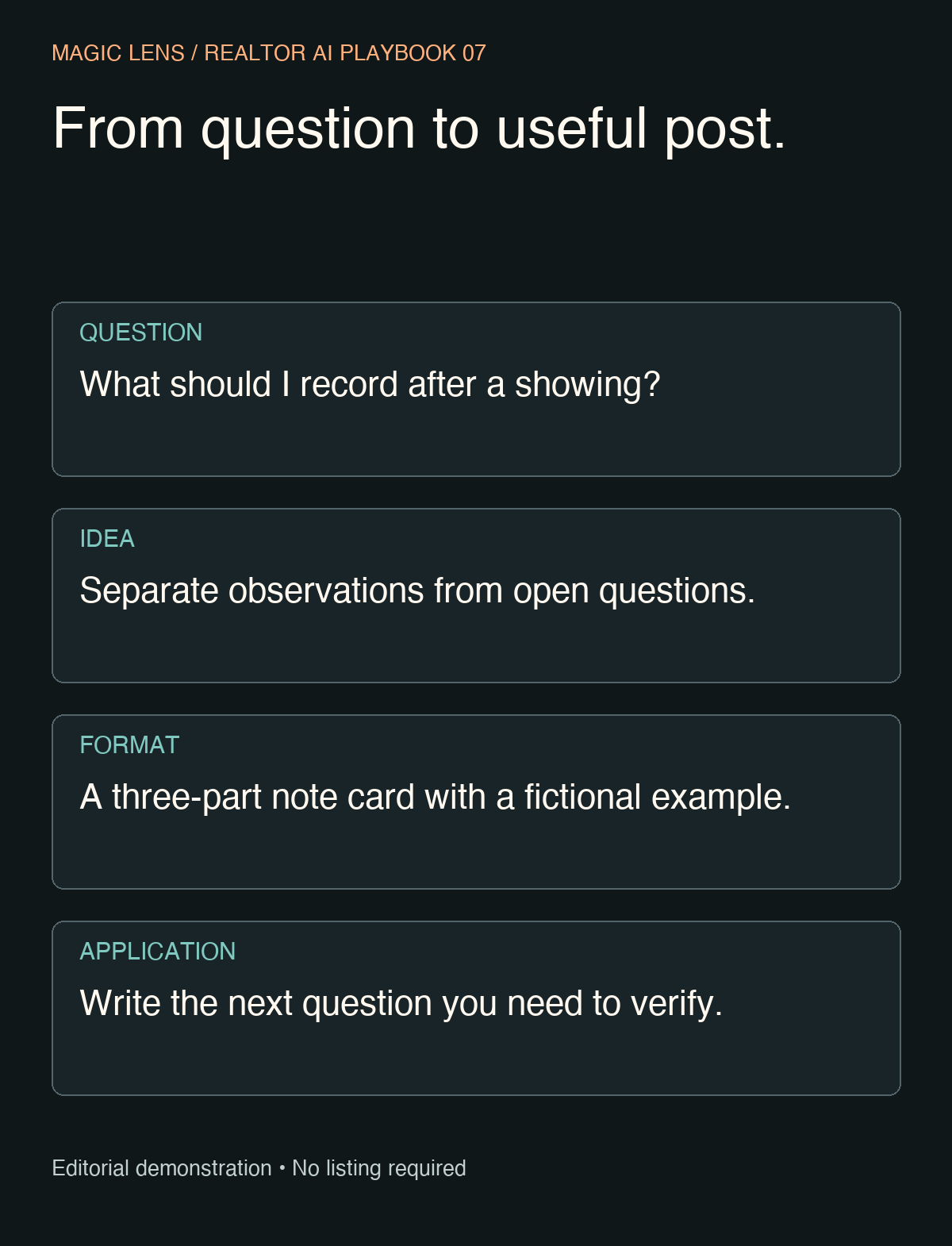
Use four decisions: question, idea, format and application. The question is what the reader needs to understand. The idea is the single point you will explain. The format is how you will show it. The application is what the reader can do afterward.
Question: “What should I record after a showing?”
Idea: separate what you observed from what you still need to verify.
Format: a three-part note card with one fictional example.
Application: complete the card after the next showing, then bring the open questions to your agent.
The format comes third. Choosing “Reel” first can lead you to search for something to say after you have already committed to filming. Choose the job of the content, then select a format that makes that job easier.
Ask ChatGPT for a structured idea bank
Help me turn real estate process questions into useful content.
I do not want to invent listings, clients, experience or results.

QUESTIONS: [PASTE QUESTIONS WITH IDENTIFYING DETAILS REMOVED]
SOURCE OF EACH: [ACTUALLY HEARD / EDITORIAL QUESTION / PUBLIC SOURCE]
WHAT I CAN EXPLAIN FROM MY PROCESS: [FACTS]
WHAT NEEDS VERIFICATION: [GAPS]
MATERIAL I HAVE PERMISSION TO USE: [TEXT / DIAGRAMS / PHOTOS]

For each question, return:
1. One focused idea.
2. A suitable format and why it fits.
3. A practical action for the reader.
4. The evidence or review needed before publication.
5. A clear label if an example is fictional.

Avoid generic motivation, invented anecdotes and performance claims.
Do not turn an educational question into a claim that a client asked it.
Prefer ideas I can complete with the material I actually have.
Review the suggested ideas for duplication. “Three showing tips,” “showing mistakes” and “how to prepare for a showing” may be the same explanation with different packaging. Keep distinct tasks, not merely distinct titles.
A 12-idea starter bank without a new listing
These are editorial questions for practice, not claims about conversations with actual clients. Adapt them to your approved process and verify any specific facts you add.
Before a conversation
1. What should I bring to a first conversation? Create a question sheet covering priorities, timing and information to clarify. Use a text checklist. The reader leaves with three questions to ask, not an instruction to upload private documents publicly.
2. How do I explain what I need in a home? Show a simple distinction between essential requirements, preferences and questions. Use a blank worksheet. The reader can organize their own criteria without being told which neighborhood or home is right for them.
3. What does “not confirmed yet” mean? Explain the difference between requesting an appointment and receiving confirmation. Use a two-state diagram. Check the wording against your actual scheduling process.
Before and after a showing
4. What should I record after a showing? Offer an observation, question and next-step note card. A fictional example can demonstrate it without borrowing another agent's listing.
5. How can I compare two homes without relying on memory? Build a blank comparison sheet using the same criteria for both. Leave unknown information marked unknown. Do not invent measurements or property conditions to complete the table.
6. What can a photograph tell me—and what can it not? Explain visible layout clues versus details that require measurements or confirmation. Use a permitted image or a clearly labeled text diagram. The reader leaves with questions to verify, not a conclusion about hidden conditions.
Before listing media
7. Which preparation items should we discuss before photos? Create a short discussion checklist: intended rooms, visible personal items, pets and access arrangements through the approved channel. Tailor it to the actual shoot scope.
8. Why plan the order of a property story? Explain how an overview, connection and detail answer different questions. Use a storyboard diagram. You can teach sequence without claiming that it guarantees a sale.
9. What questions help define the media brief? Offer a brief with the property's confirmed features, unresolved questions and available materials. The reader can prepare for a conversation with a media provider.
After information arrives
10. How should I read a market headline? Make a source-check card: report date, area, metric and comparison period. Use a real current source if you include numbers. Without a source, teach the questions and leave numerical claims out.
11. What belongs in a useful appointment recap? Show a fictional recap with the agreed action, responsible person and confirmed timing. The reader can check whether the next step is clear.
12. What should I do when an answer is still missing? Explain how to record the open question, who will verify it and the agreed follow-up. Use a blank tracker rather than implying that uncertainty is a problem AI can solve by guessing.
Complete example 1: the showing note card
Post opening: “After a showing, separate what you saw from what you still need to verify.”
Use three lines before the details blur together:
Observed: What did I directly notice?
To verify: Which question needs a reliable answer?
Next step: Who will help me check it?
Fictional example: “I saw a dining area beside the kitchen. I need to verify whether my table fits. My next step is to obtain the relevant measurements.”
A photograph or quick impression can start a question. It does not replace the measurement or confirmation you need. Save this structure and use it after your next showing.
The post gives the reader a tool. It does not claim to inspect a property, diagnose a condition or recount a real showing. The fictional example is narrow enough to make the distinction clear.
Complete example 2: the appointment recap
Post opening: “A useful recap makes the next action easy to identify.”
Before ending an appointment recap, check three things:
What did we agree to do?
Who is responsible for doing it?
What timing did we actually confirm?
Fictional example: “You will send the three preparation questions you want to discuss. I will review them before our confirmed call.”
If no deadline was agreed, do not invent one in the recap. Clarify it. A short summary should help both people understand the same next step.
This is process education. It remains useful even when you have no active listing to feature. If you use a real example later, obtain the appropriate permission and remove unnecessary personal details.
Two refinements for a stronger draft
Choose the three ideas that need the least new material from me.
For each, explain the reader's practical gain and list exactly what
I must verify. Reject any idea that depends on an invented case.
This keeps the plan realistic. An idea requiring a current market report is not ready just because the caption is written. A simple worksheet may be ready sooner and still provide clear value.
Develop idea [NUMBER] into one complete post. Include a direct
opening, the useful explanation and one action. Label any invented
example as fictional. Remove any claim of personal experience
unless it appears in my supplied facts.
Read the draft as someone unfamiliar with your business. Can they do something after reading it? If the only takeaway is “hire a great agent,” the explanation probably needs more substance.
A beginner can explain a process honestly
If you have no client questions yet, use questions you are learning to answer and confirm the explanation with appropriate sources or your brokerage. Say “Here is a preparation framework” rather than “My clients always ask.” You do not need a fictional history to make a useful contribution.
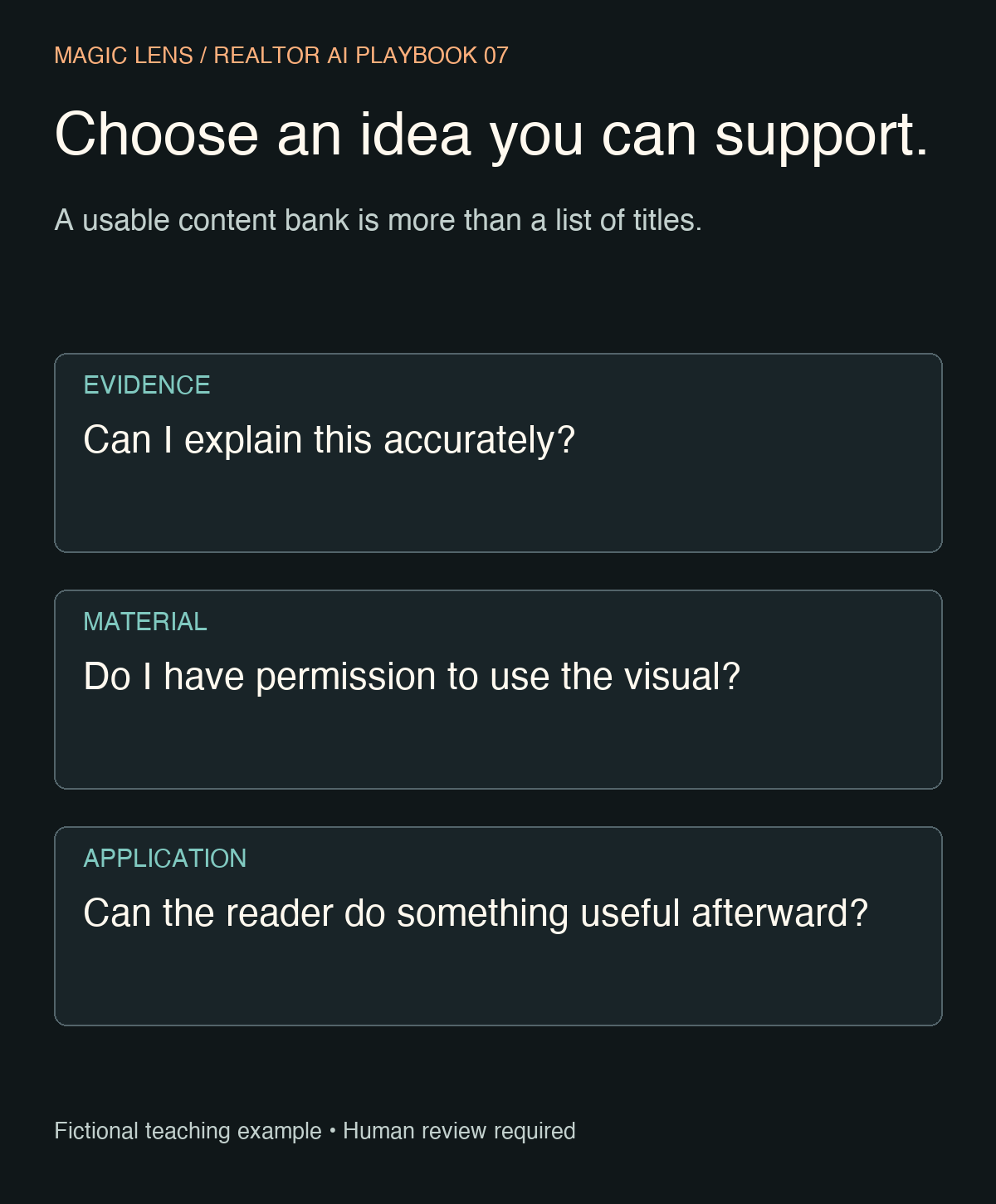
Use your own diagrams, original text and material you have permission to use. Do not present another agent's property as your listing. If you cannot source an image responsibly, a well-designed checklist may be the better visual.
Your question-to-content card
QUESTION:
SOURCE: actually heard / editorial question / public source
ONE IDEA:
WHAT I KNOW:
WHAT I MUST VERIFY:
FORMAT + AVAILABLE MATERIAL:
ACTION THE READER CAN TAKE:
FICTIONAL EXAMPLE LABEL, IF NEEDED:

READY CHECK
[ ] One useful task, not several unrelated tips.
[ ] No invented client story or experience.
[ ] Facts and sources checked.
[ ] Visuals are permitted and accurately described.
[ ] The reader can apply the explanation.
Choose one idea from the bank and complete the card. Finish that post before collecting more ideas. A smaller bank of explanations you can support is more useful than a large list that depends on material you do not have.
Build a useful visual library when you do have a shoot
You now have ideas that do not depend on a new listing. When the next property assignment arrives, think beyond the announcement: an overview, a room connection and a useful detail can support different explanations later, where your usage rights allow it.
Bring those questions into your photography brief. Magic Lens services and pricing give Central Florida agents a starting point for choosing the coverage their future content actually needs.