

REALTOR AI PLAYBOOK · 02
Better Marketing. Stronger Conversations. Practical AI.
If every ChatGPT caption could belong to any real estate agent, check what you supplied before blaming the wording. “Write a post for a Realtor in Orlando” gives a location and a job title. It does not explain what you do, what you can prove or what the reader needs to understand.
Try this now: write one sentence beginning “I help clients understand…” Then name one process you actually use and one claim you cannot yet support. You have started a useful agent brief. It should describe your real work, not an imagined version of your business.
This chapter helps you build a one-page brief you can paste before a writing task. You will get a blank template, a fictional filled example and two prompts for improving the result. The brief supplies context; your next prompt still supplies the assignment.
A brief is not a biography
A biography often tells the story of an agent's career. A working brief tells a writing assistant which facts matter for the next piece of communication. It can include experience, but it should not become a long list of adjectives or a private dossier about clients.
“Dedicated, passionate and results-driven” gives the model little to work with. “I give sellers a written preparation checklist before photography, then review their questions before the shoot” describes a process. The second statement can support a useful article, reminder or conversation, provided it is true.
Think of the brief as a small set of editorial instructions backed by facts. A tool can use it to choose relevant examples and avoid claims outside your experience. It cannot verify a credential merely because you put it in the brief.
Keep changing facts separate. Current listing availability, this month's market figures, an event date and a client's circumstances belong in the individual task. Mixing them into an evergreen brief makes them easy to reuse after they are outdated.
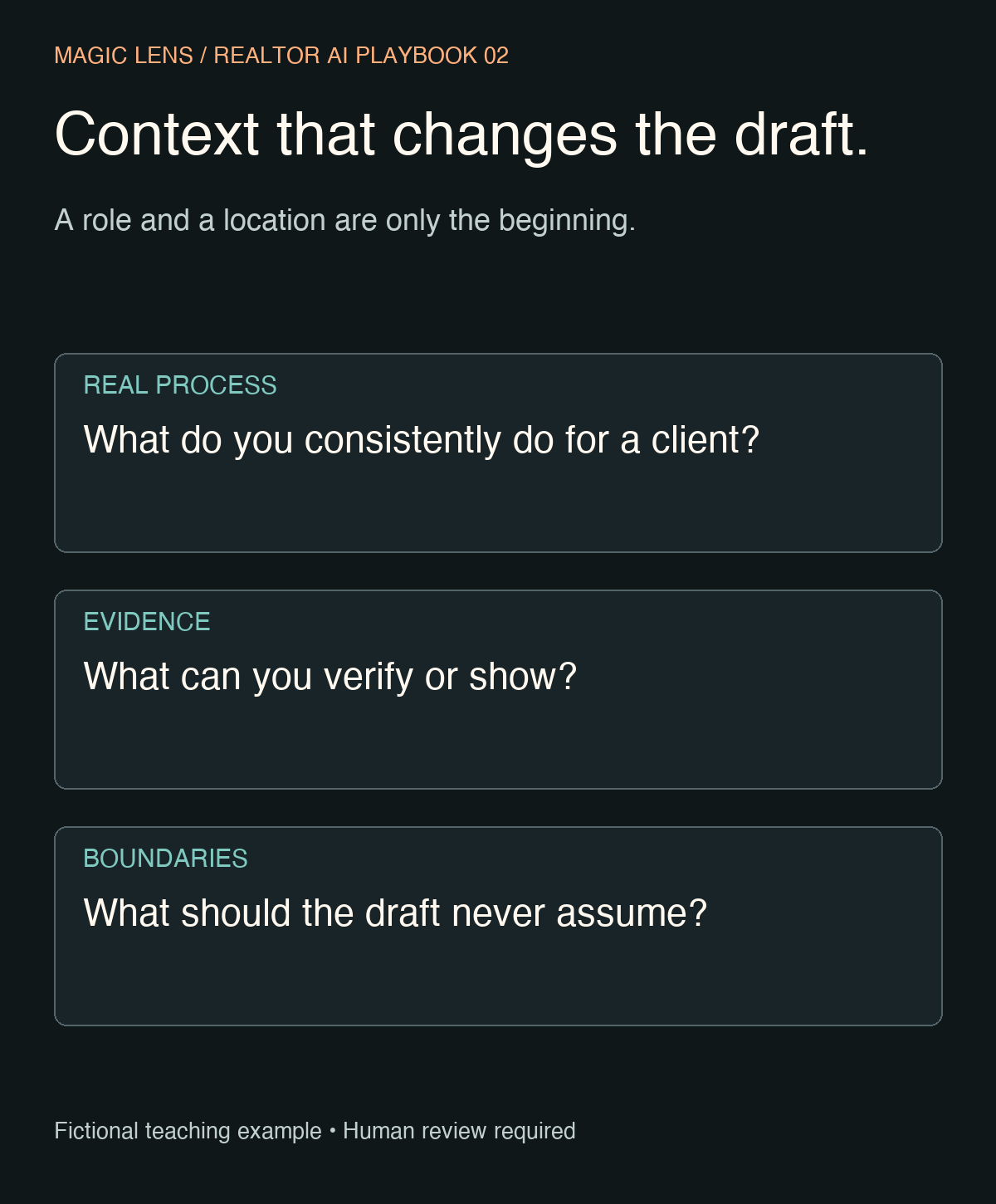
Build the page around seven useful decisions
1. State your role and service area accurately
Use your actual professional role and the places you serve. “Real estate agent working in the Orlando area” is different from “Orlando's leading luxury expert.” The second claim needs evidence and a meaningful definition. A new agent does not need to borrow a senior agent's track record to sound clear.
If a particular designation, language ability or specialty matters, confirm that you can represent it accurately. Leave a line blank rather than asking ChatGPT to make your experience sound bigger than it is.
2. Describe client questions, not demographic assumptions
Useful context includes “sellers who want to understand the preparation process” or “buyers comparing available property information.” These are tasks and questions. Do not instruct the model to decide which people belong in which neighborhoods or invent a preferred resident profile.
You can write for someone new to a process without making assumptions about age, family status, religion, disability or background. Focus on the information the reader is asking for and the service you provide.
3. Name processes you actually deliver
Choose two or three observable actions: a preparation checklist, a documented communication schedule, a verified property comparison or a media planning meeting. Do not list “24/7 availability” if you cannot deliver it. Do not claim a weekly update process if you have not established one.
A process gives the content a specific topic. It also gives a prospective client something concrete to ask about. The brief should help you communicate your service accurately, not create new promises by accident.
4. Separate evidence from aspiration
Evidence might be an approved sample checklist, a published project or a documented credential. Aspirations might include becoming a stronger listing agent or building a video library. Both can matter to you, but they play different roles in public content.
Write “developing a seller education series” if that is the current state. Do not transform it into “trusted by hundreds of sellers” without records supporting the claim and permission to use any client examples.
5. Define your communication style in practical terms
“Warm and professional” is a starting point. Add instructions a reviewer can recognize: short paragraphs, plain language, one clear question, no exaggerated praise and no pressure-based urgency. A style guide becomes more useful when it names what to avoid.
6. Record boundaries
Tell the model which information it must not invent: sales results, testimonials, property features, pricing, credentials, statistics or current availability. Also identify areas where you need another qualified professional or verified source.
7. List next steps that really exist
A call to action should lead somewhere real. If you have a preparation checklist, say how a person can request it. If you do not, do not ask the model to advertise one. For an early-stage agent, a specific invitation to ask a process question may be enough.
Your one-page agent brief
AGENT BRIEF — VERSION [DATE]

ROLE AND SERVICE AREA
[Accurate role, locations and relevant verified qualifications]

QUESTIONS I HELP PEOPLE ANSWER
[Two or three practical needs, without demographic assumptions]

PROCESSES I ACTUALLY USE
[Specific actions I can consistently deliver]

EVIDENCE I MAY REFER TO
[Approved examples or verified facts, with sources]

VOICE
[Sentence length, tone, useful vocabulary and words to avoid]

BOUNDARIES
[Claims not supported; facts requiring verification; private data excluded]

AVAILABLE NEXT STEPS
[Real resources, contact methods or actions]

VARIABLE FACTS
I will supply current listing details, dates and market figures separately.
Ask when essential information is missing. Do not fill gaps with guesses.
Keep the actual brief short enough to read before each use. If a line does not help the tool select, explain or check something, remove it. You can maintain supporting documents separately without pasting the entire business into every conversation.
A filled example that does not invent authority
The following is a fictional demonstration, not a profile of Gustavo or a real agent. It shows how a newer agent can provide useful context without claiming an unsupported track record.
Role: A newly licensed real estate agent working under brokerage supervision in the Orlando area.
Questions: What should a seller prepare before listing media? What information should a buyer confirm before arranging a tour?
Process: Use the brokerage-approved preparation checklist, identify unanswered questions and confirm arrangements before treating an appointment as booked.
Evidence: The approved checklist and verified property information supplied for each task. No personal sales record or testimonials provided.
Voice: Direct, friendly and specific. Short paragraphs. Avoid “dream home,” “guaranteed results” and invented urgency.
Boundaries: No claims of years of experience, sales volume, neighborhood suitability or current property status unless separately verified.
Next step: Invite a reader to ask a specific preparation question. Do not advertise a downloadable resource that has not been created.
This brief does not make the agent an expert by declaration. It gives the writing task a truthful foundation. The agent can explain the preparation process and know which questions require confirmation.
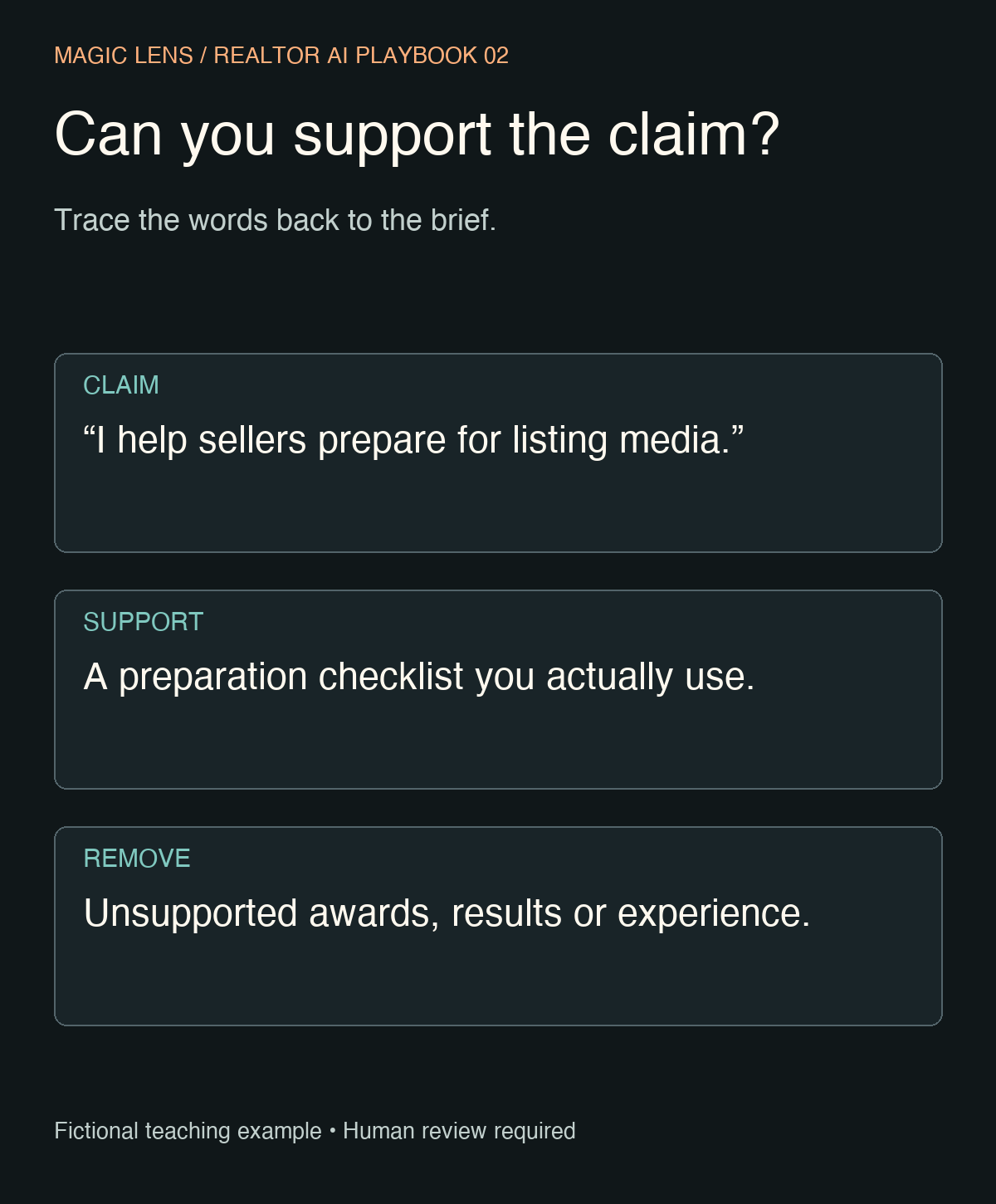
Use the brief with a small assignment
Use the agent brief below as context for this task only.
[PASTE MY CHECKED AGENT BRIEF]

Assignment: Draft a short educational post answering this question:
[ONE READER QUESTION]
Verified facts or source material for this post: [FACTS / SOURCE]
Format and length: [FORMAT / APPROXIMATE LENGTH]
Real next step available to the reader: [ACTION]

Do not add experience, results, testimonials, property details or
services not supported by the brief and task facts. Ask if essential
information is missing. Return the draft, then list claims I must verify.
For our fictional agent, use the question “What should I check before the photographer arrives?” and supply the approved checklist as the source. The brief tells the model to teach a process, avoid inflated experience and use a real next step.
Illustrative weak opening: “As Orlando's trusted real estate expert, I know exactly how to make every home sell faster.”
Illustrative improved opening: “Before the photographer arrives, review the preparation checklist and flag anything you cannot complete. That gives your agent time to discuss the next step with you.”
The second opening fits the supplied process. It does not promise a sale, invent recognition or imply that one preparation step guarantees a result. You still need to check the rest of the post against the source checklist.
Two ways to repair a generic result
If the draft sounds interchangeable, ask the model to show its connection to the brief:
Identify which sentence in this draft uses each relevant part of my brief.
Flag statements that could describe any agent. Replace only those
statements with a concrete explanation of a process I actually supplied.
Do not add new achievements or claims to make the writing distinctive.
If the draft sounds more experienced than you are, audit the claims directly:
List every claim about my experience, service, results or expertise.
For each, quote the supporting fact from my brief. If there is no support,
remove it or turn it into a question for me. Then return a corrected draft.
The point of the audit is traceability. “You are a local expert” is not evidence just because the model inferred it from your location. Do not let flattering language pass a check you would apply to a competitor's advertisement.
Maintain the brief without making it a second job
Put a version date at the top. Review it when your role, service area, process or available resources change. Before each task, skim the boundaries and replace any stale fact. A brief that takes longer to maintain than the work it supports is too complicated.
Keep client identities and private case details out of the reusable version. A public-facing service description rarely needs them. If a task requires sensitive information, stop and follow your approved data-handling workflow rather than treating this template as permission to share it.
If you are new, start with the questions and process sections. If you have an established business, resist the temptation to paste every accomplishment. Choose evidence that helps with the task at hand. The same brief should improve focus, not overwhelm the model with competing instructions.
The test: can another person check it?
AGENT BRIEF CHECK
[ ] Each claim describes my current, real work.
[ ] Client needs are expressed as questions or tasks.
[ ] Every achievement has support or has been removed.
[ ] The voice instructions are observable.
[ ] The next steps and resources actually exist.
[ ] Changing property facts stay outside the reusable brief.
[ ] No unnecessary client information is included.
[ ] The version date is current.
Complete your page, then use it for one small post or email. Compare the draft with the brief and ask whether the writing became more specific without becoming less accurate. If it did, you have a useful foundation for the rest of this playbook.
Let the visuals support the brief
Your agent brief now describes the work you can stand behind. The next check is whether your listing materials show that same care. If your promise is a clear explanation of the property, the photographs should help a buyer understand its spaces—not leave your captions to explain what is missing.
For an upcoming listing in Orlando or Central Florida, Magic Lens can help plan the photography around those questions. Review our services and pricing to see what fits the property.